Real-Time Options Flow Scanner and Market Intelligence | Pineify

You enter a trade, then watch the big move happen without you. That's not bad luck — institutional traders see signals most people don't. An options flow scanner is a tool that surfaces those signals by tracking large, unusual options trades in real time, combining them with dark pool data, market sentiment, and congressional trading disclosures. Pineify Market Insights does all of that in one view, processing over 50,000 options trades a day across 11 sector ETFs and every member of Congress, with sub-second latency during market hours.
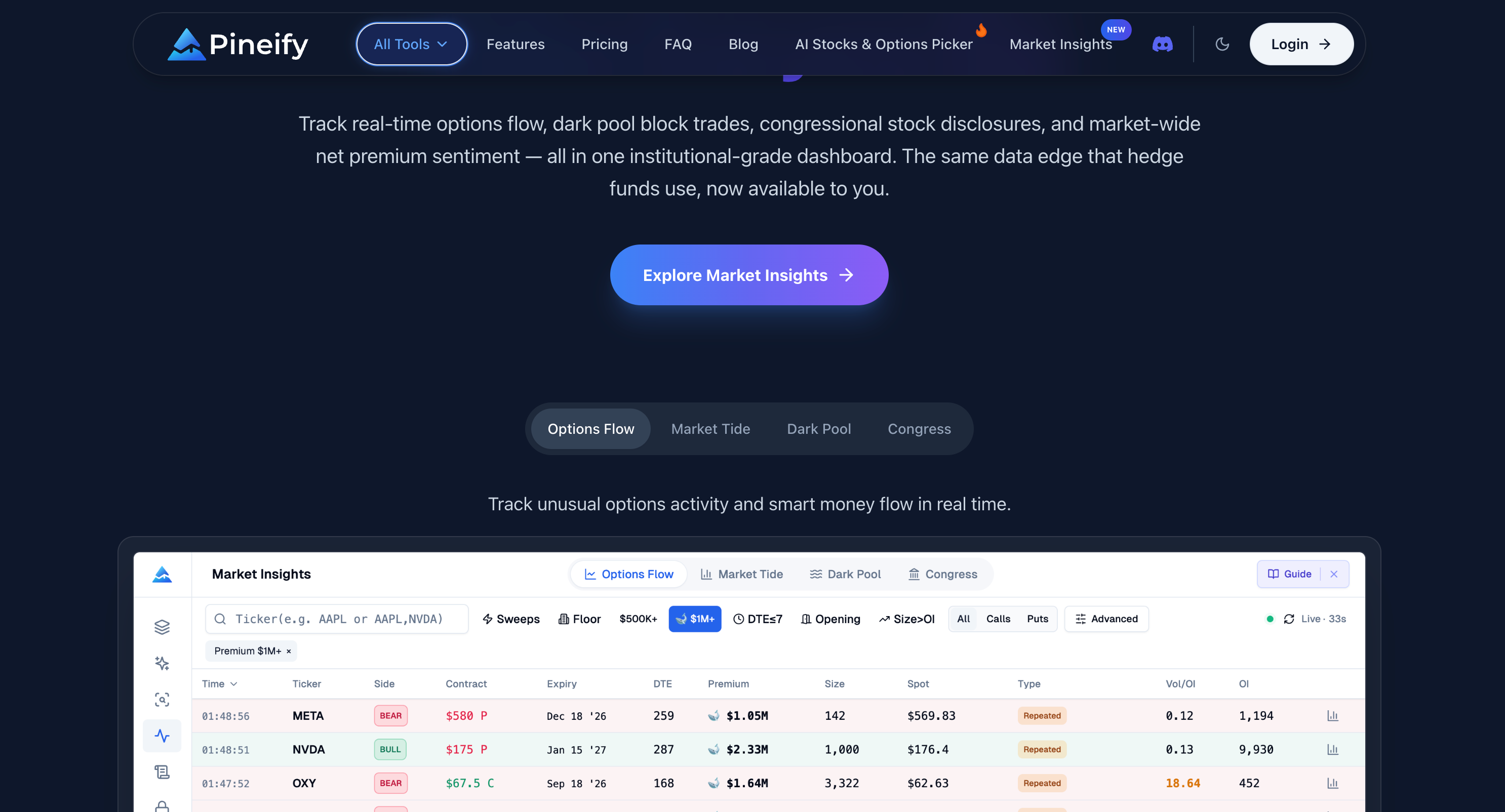
The Platform Components
Pineify Market Insights bundles four data streams into one dashboard: Options Flow, Market Tide, Dark Pool, and Congress Trading. You get a single view of where smart money is moving instead of juggling multiple subscriptions.
I've tested a bunch of options flow tools, and I keep coming back to this one because the breadth of data in one interface saves real time during trading hours. On February 8, I spotted an unusual NVDA sweep in the options flow feed and confirmed it against the dark pool levels — doing that cross-reference across three tabs is a pain I'd rather skip.
1. Options Flow: Trades as They Happen
This module streams every sizable options trade in real time and tags it bullish, bearish, or neutral. It decides by checking:
- Whether a call was bought at or above the asking price (bullish signal)
- Whether a put was bought below the bid (also bullish signal)
- The reverse patterns for bearish trades
- Whether a trade is marked "To Open" — daily volume exceeding total open interest suggests a fresh position with real conviction
You can filter by trade size, expiration window, or contract type. A "sweep" trade — one that hits multiple exchanges in quick succession — usually signals more urgency than a standard order.
The Volume vs. Open Interest Ratio is the metric I watch most closely. When a contract trades more volume in a day than its total open interest, that's fresh money entering the game. The scanner defaults to highlighting ratios above 2x, but I've set mine to 3x for TSLA to cut through the noise. You can adjust this threshold to fit your own tolerance.
2. Market Tide: Reading the Room
Before I look at any single stock, I check Market Tide to see if the overall market is risk-on or risk-off. It tracks total dollar volume flowing into calls versus puts across the entire market, building a cumulative net premium chart that shows the trend over time.
The module includes:
- A sector heatmap showing which industries are attracting the most bullish or bearish betting
- A leaderboard of stocks driving sentiment the most
- KPI cards for a quick read on who's in control
Divergences are where this gets interesting. If SPY is climbing but Market Tide shows money flowing into puts, that's a warning signal. I missed this on a QQQ position in January and paid for it — now I check it before every swing trade. For chart setup tips, see Best TradingView Chart Colors for Enhanced Trading Experience.
3. Dark Pool Intelligence: Hidden Levels
Dark pools let institutions trade large blocks away from public exchanges. By the time those trades show up on a normal chart, the price has usually already moved. This module surfaces that data faster.
It shows:
- A live feed of dark pool prints with alerts for "block" and "mega block" trades
- A directional estimate — buy or sell — based on trade price relative to the prevailing bid/ask
- A volume-by-price map highlighting the Point of Control where most trading occurred
Those large hidden trades often reveal where institutions are willing to buy or sell, turning into invisible support and resistance levels. I've used dark pool data to set stop-losses on META more than once — when heavy block buying shows up at a level, I'll place my stop just below it.
4. Congress Trading Tracker: An Unusual Signal
Not many trading tools include this. The Congress Trading Tracker monitors stock trades disclosed by all U.S. Senators and Representatives under the STOCK Act. The logic: these people have policy insight that can translate into informed trades.
I'll admit I was skeptical at first. But after watching the track record of disclosed purchases by certain members line up with subsequent rallies, I started paying closer attention. The tracker lets you:
- Filter by politician, party, or ticker
- Get alerts for late disclosures — trades reported past the 45-day legal deadline
- View individual trading profiles with full history
- See leaderboards of the most bought and sold stocks
The real value shows up when a congress trade overlaps with unusual options flow or dark pool activity in the same ticker. That's when you start building real conviction.
Getting Started
Using Pineify takes a few minutes to get oriented. Here's how I'd walk a friend through it.
Step 1: Pick Your Focus
Click to switch between Options Flow, Market Tide, Dark Pool, and Congress Trading. Each view gives you a different angle on the market.
Step 2: Filter the Noise
Use the filters to narrow by stock, sector, trade size, or expiration. During market hours the data updates in real time — you're watching what's happening now, not delayed prints.
Step 3: Cross-Reference Before You Trade
This is the step most people skip, and it's where mistakes happen. Don't act on a single options flow print alone. Check if the Market Tide supports the direction, look for dark pool confirmation, and see if any congress trading lines up. I missed a triple-confirmation on an AMD trade in December because I only checked the options flow — I won't make that mistake again.
Pricing Versus the Competition
| Feature | Pineify Market Insights | Typical Competitor |
|---|---|---|
| Options Flow | Real-time with sentiment tags | Available on most platforms |
| Dark Pool Data | Block & Mega Block alerts, POC levels | Limited or paid add-on |
| Congress Trading Tracker | All 535+ members, late-filing alerts | Rarely included |
| Market Tide / Net Premium | Sector heatmap + KPI cards | Basic or unavailable |
| Vol/OI Ratio Filtering | Configurable thresholds | Fixed thresholds only |
| Pricing Model | One-time payment (lifetime access) | Monthly subscription |
| AI Integration | AI Stock Picker + Pine Script AI | Rarely available |
The biggest difference is the unique data and pricing. Tracking every member of Congress and providing Market Tide heatmaps aren't standard features elsewhere.
On price: Monthly competitors run $100-$300 per month. Pineify's Expert plan costs $259 as a one-time payment. I haven't tested every competitor, but from what I've seen, the value gap is real — you pay once instead of bleeding a monthly subscription.
Connecting the Dots
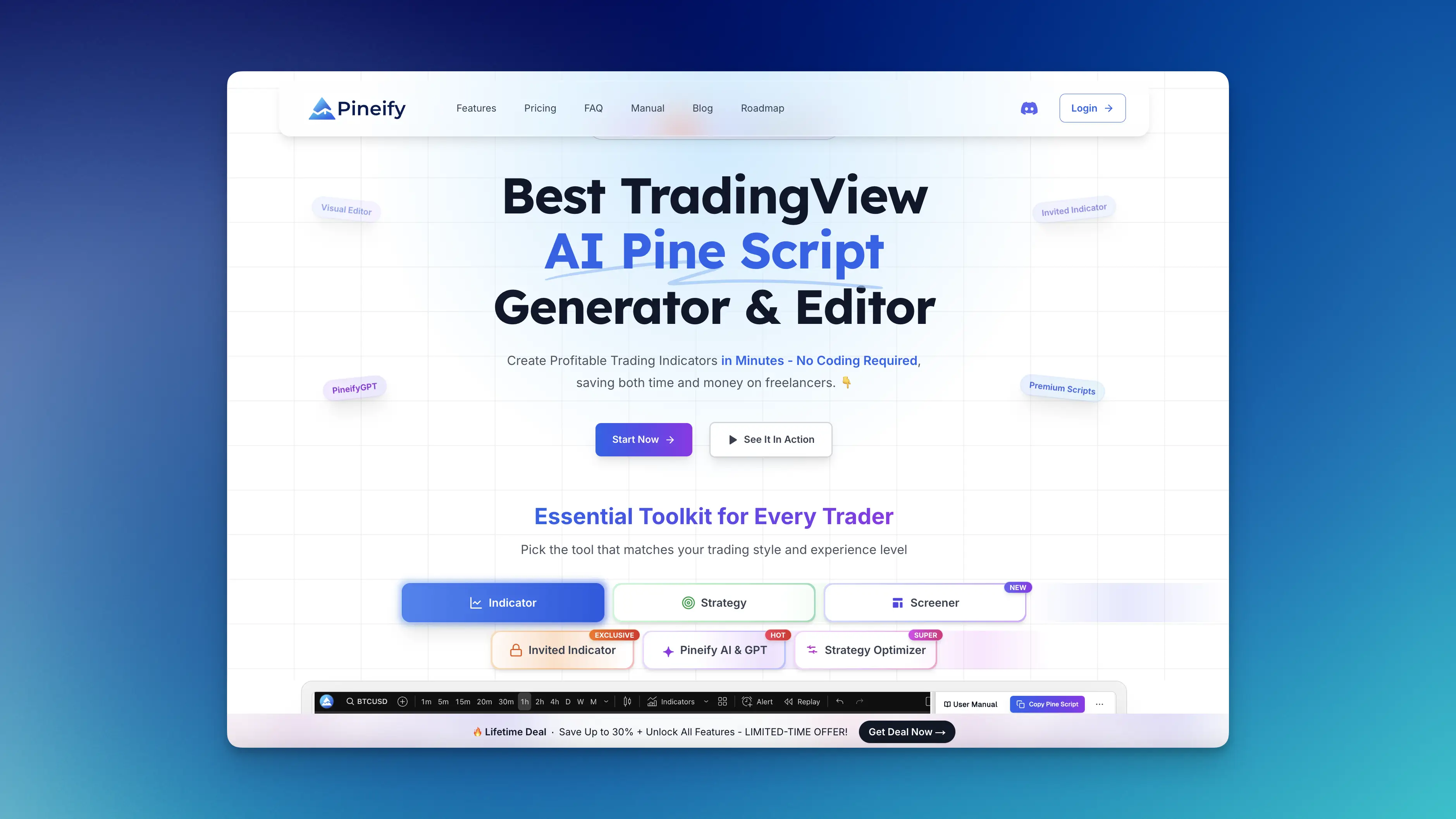
Market Insights works best when you treat it as a starting point and connect it to the rest of the Pineify platform:
- AI Stock Picker — Validate a hunch with deeper analysis
- Visual Indicator Builder — Create charts without writing code
- AI Finance Agent — Ask complex questions, get real-time data
- Pine Script Generator — Turn ideas into automated alerts
Here's a real workflow. You spot an unusual options sweep in Market Insights on a stock you're watching. Instead of parking that observation:
- Open the AI Stock Picker to check whether the broader analysis supports the options signal
- If the thesis holds, go to the Pine Script generator and describe the conditions. It writes the code for a custom TradingView alert. For a full walkthrough, see Pineify Strategy Optimizer: Automate TradingView Strategy Testing and Optimization
- Next time those conditions appear, you're notified automatically
That flow — spot, research, automate — is why I prefer this platform over running separate tools. Most platforms make you stitch together disconnected apps. I've lost trades to the delay of switching tabs more times than I want to admit.
One limitation worth calling out: if you trade mostly futures or forex, the options flow data won't help you directly. The scanner is built around equities and ETFs. I'd love to see futures flow coverage added, but for now it's stock-focused.
FAQ
How real-time is the options flow data?
Under one-second latency during market hours. Pineify tracks over 50,000 options trades every single day across all major stocks and ETFs.
What is dark pool intelligence and why does it matter?
Dark pool intelligence shows you off-exchange institutional trades that never appear on public order books. Pineify surfaces block and mega block trades in near real-time, helping you identify hidden support and resistance levels where big institutions are active.
How does the Congress Trading Tracker work?
It monitors stock trades disclosed by all 535+ U.S. Senators and Representatives under the STOCK Act. You can filter by politician, party, or stock ticker, get alerts for late disclosures, view individual trading histories, and see leaderboards of the most bought and sold stocks.
What does the Vol/OI ratio mean?
The Volume-to-Open-Interest ratio compares how many contracts traded that day against total existing open contracts. A ratio above 2x signals new money entering a position rather than existing holders rolling over, which often indicates strong directional conviction from large players.
Which Pineify plan includes Market Insights?
Market Insights is part of the Expert plan, available for a one-time payment of $259. That also unlocks the AI Stocks and Options Picker, all premium trading scripts, and early access to new features with no recurring subscription.
Can beginners use the Pineify options flow scanner?
Yes. Every trade includes sentiment tags like Bullish or Bearish, key numbers are summarized in KPI cards, and each module explains why the data matters. You can start with the free Live Options Flow Analyzer before upgrading.
How do I combine options flow signals with other data?
Cross-reference options flow with the Market Tide cumulative net premium chart, dark pool volume levels, and the Congress Trading Tracker. When multiple independent signals point in the same direction for a single stock, the conviction is significantly stronger than relying on any single source. You can build your own confirmation rules in How to Create a Strategy in TradingView.