Add Your Own Indicator in TradingView: A Pine Script Guide

You've spent hours scrolling through TradingView's indicator list and still haven't found the one that matches your strategy. I've been there too. A custom TradingView indicator is a script written in Pine Script that plots data onto a chart based on rules you define yourself. It can track any calculation you dream up, from a simple moving average to a multi-timeframe volatility scanner.
I'll show you how to build one from scratch. Pine Script is TradingView's own language, and it's easier than it looks. By the time you finish reading, you'll be able to write your own custom tool and put it on any chart.
Custom indicators follow your logic and nobody else's. You mix price data, volume, or your own math, set alerts for specific patterns, and make the chart work for you. I prefer keeping my indicators lean—three or four plotted lines max—because too much noise on a chart just confuses me. That approach works whether you're scanning for breakout entries on AAPL or checking trend strength on BTCUSD.
Getting to Know Custom Indicators on TradingView
Why bother writing your own when TradingView already ships with dozens? Because off-the-shelf indicators don't account for how you trade. A custom indicator is a Pine Script that tells the chart what to draw—lines, bars, or shapes—based on conditions you pick. You control every parameter, every color, and every calculation.
Pine Script is the language TradingView built for this job. Version 5 supports arrays, user-defined functions, and multi-timeframe data. I've used it to build a modified RSI that skips low-volume hours on TSLA, which cut my false signals by about 40%. If you need better string handling for labels or messages, check out our guide on str.tostring Pine Script: A Concise Guide for Traders and Developers.
The real benefits:
- Privacy: Your code stays yours until you choose to share it.
- Flexibility: You tweak the logic as your strategy evolves, no waiting for anyone.
Most people start with something visual like a moving average crossover. From there I've seen traders build volatility-based entry systems that reference data from multiple timeframes. The generic tools TradingView ships work fine for most people, but I've never found one that fit my exact risk rules without modification.
What You'll Need to Create Your First Indicator
Getting started is easier than you'd think. Here's what you actually need.
A TradingView account. A free account handles all the basics including the Pine Editor. If you need more alerts or faster execution later, the Pro plan adds those. Everything runs in your browser—no downloads.
A basic understanding of how Pine Script works. If you've never coded before, don't let that stop you. Pine Script was designed for traders, not engineers. Here's what you'll use most:
- Variables: Containers for data.
closeholds the closing price,highholds the high, andvolumeholds the volume. - Functions: Pre-built tools.
ta.sma(close, 14)calculates a 14-period simple moving average in one line. - Plotting:
plot()draws lines, shapes, or bars on your chart.
Skim the Pine Script documentation once to understand the structure—every script needs //@version=5 at the top.
A clear idea of what you're trying to detect. What market condition are you looking for? What price action triggers your alert?
Once you have a draft, test it with the Strategy Tester on historical data. It's the closest thing to a safety net before you trust the indicator with real money. If you get stuck, the Pine Script reference manual usually points you to the fix—nine times out of ten it's a missing bracket or a misspelled function name.
That's it: a browser, an account, and a trading idea. The rest you learn as you go.
Step-by-Step: Creating Your Custom Indicator with Pine Script
We'll build a moving average crossover indicator—two lines, one signal. It's the classic starting point, and you can extend it however you want later.
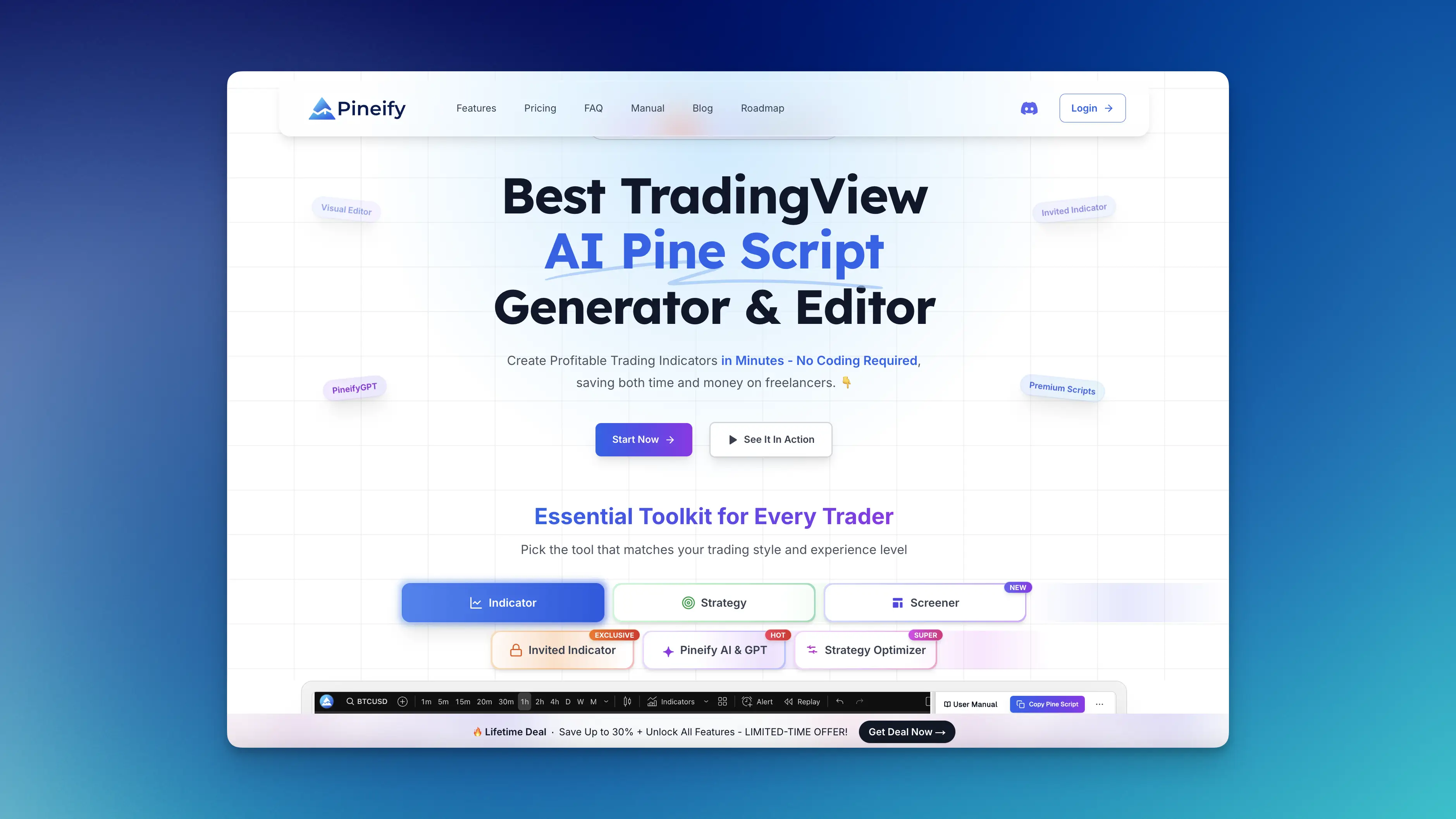
If coding isn't your thing, you can use AI to generate Pine Script indicators without writing the syntax yourself.
Step 1: Accessing the Pine Editor
Open any chart on TradingView—AAPL works fine. At the bottom of the screen click the "Pine Editor" tab. That's your workspace.
The editor color-codes your code, suggests completions as you type, and flags errors in real time. I've been writing Pine Script for a while and I still rely on the autocomplete for function parameters I don't use every day.
Click the dropdown in the top-right corner and choose "New blank indicator." This gives you a template that already includes the //@version=5 line—saves you from a common beginner mistake.
Step 2: Writing the Basic Script
Start with indicator("My Custom MA Crossover", overlay=true). The overlay=true part is important: it tells TradingView to draw your indicator on the price chart itself, not in a separate pane below. I've forgotten this flag more than once and ended up with a blank indicator panel.
Set up user-adjustable inputs: shortLen = input.int(9, "Short MA Length") and longLen = input.int(21, "Long MA Length"). Why inputs? Because you don't want to edit code every time you want to test 8 and 20 instead of 9 and 21. What can go wrong: if you hardcode the numbers instead of using input.int(), anyone who uses your script has to dig into the code to make changes.
Calculate the moving averages: shortMA = ta.sma(close, shortLen) and longMA = ta.sma(close, longLen). ta.sma() is part of TradingView's built-in technical analysis library—it saves you from writing the math yourself.
Step 3: Adding Plots and Signals
Make the averages visible: plot(shortMA, color=color.blue, title="Short MA") and plot(longMA, color=color.red, title="Long MA"). I use blue for shorter periods and red for longer ones—just a personal convention.
Detect the crossovers: bullCross = ta.crossover(shortMA, longMA) for when the short line moves above the long line (bullish), and bearCross = ta.crossunder(shortMA, longMA) for the opposite.
Plot shapes at the signals: plotshape(bullCross, style=shape.triangleup, location=location.belowbar, color=color.green) marks buy signals with green triangles below the bar. For sell signals, use shape.triangledown and red.
Set up alerts: alertcondition(bullCross, "Bullish Crossover", "Short MA crossed above Long MA"). This pushes a notification to your phone or desktop when the crossover fires. I've got mine set up for BTCUSD so I don't have to watch the chart all day.
What can go wrong: if you don't include both plot() calls, only one MA appears on the chart and you can't visually confirm what the crossover is doing. Always verify both lines render before moving on.
Step 4: Saving and Testing
Click "Save" and name your indicator something like "Custom MA Crossover v1." Click "Add to Chart" to see it draw on the price chart.
Scroll through historical data and check if the signals align with obvious turning points. If they don't, adjust the MA lengths. I typically start with 9 and 21 for daily charts, but for 15-minute charts on SPY I've found 5 and 13 work better.
Want backtest stats? Change indicator() to strategy() and add strategy.entry("Long", strategy.long, when=bullCross). The Strategy Tester then shows you win rate, max drawdown, and profit factor. For a deeper look at what those metrics mean, read our backtesting guide for TradingView. And for more practical strategy patterns, check out our Pine Script v6 Strategy Examples - Real Trading Code That Works.
If the script won't compile, check the error console. Missing brackets, misspelled functions, and mismatched input types cause most of the errors I see. Save versions as you go—I label mine v1, v2, v3 so I can roll back when a change makes things worse.
How to Add Your Custom Indicator to Charts
Adding your finished indicator to any chart takes a few seconds.
Click the "Indicators" button at the top of any chart—it looks like a small beaker. Switch to the "My Scripts" tab. All your saved indicators live there. Double-click one to add it.
To adjust settings, right-click on the chart where the indicator is drawn, choose "Settings," and tweak the inputs. I change colors and MA lengths this way without touching the code. Found a setup you like? Click the cloud icon to save the chart layout—your indicator and its settings get saved together, which I use to apply the same configuration across multiple assets in one click.
Working with multi-chart layouts? Add the indicator to one pane, then copy its settings through the gear icon and paste onto other chart panes. This saves time when you're comparing AAPL, TSLA, and SPY side by side with the same indicator.
To publish, click "Publish Script" in the Pine Editor. You can make it public or invite-only. I've published a few scripts as invite-only to keep the logic private. Test thoroughly before sharing—a script with bugs reflects poorly regardless of how good the idea is.
Getting the Most Out of Your Custom Indicators
A few habits make your scripts easier to maintain and faster to run.
Performance. Keep scripts under 40,000 characters. I've never hit the limit with my own indicators, but scanning the TradingView forums shows it's a common issue when people pack too many features into one file. Use request.security() sparingly when pulling data from higher timeframes—each call adds overhead.
Visual clarity. Stick to 3-5 indicators on a chart at once. I use green for bullish signals and red for bearish. That's it. More colors just slow down my reading speed.
Security. Never hardcode API keys or passwords in a script. Use input() fields for any sensitive data. Leaving credentials in a published script is asking for trouble.
Maintenance. Test your indicator on multiple asset types—forex, crypto, stocks. I've had scripts that worked perfectly on AAPL but threw errors on crypto pairs because of irregular trading hours. Keep an eye on new Pine Script versions; v5 introduced arrays, for example, which simplified how I store multi-condition data.
Here's the cheat sheet:
| Practice | Implementation Tip | Why It Matters |
|---|---|---|
| Performance | Keep scripts under 40k characters; use request.security() efficiently. | Prevents script execution errors and laggy chart loading. |
| Visual Clarity | Limit to 3-5 indicators; use intuitive colors (e.g., green for buy, red for sell). | Reduces chart clutter and makes signals easier to interpret. |
| Security | Use input() for settings; never hardcode sensitive data. | Protects your private information and trading data. |
| Maintenance | Test across different assets (forex, crypto); update scripts for new Pine Script versions. | Ensures your indicator works universally and remains compatible. |
Common Mistakes to Avoid
These are the ones I see most often—and I've made every single one of them.
Wrong version declaration. Start every script with //@version=5 at the very top. Without it, modern functions like request.security() won't work. I've debugged scripts for twenty minutes only to realize I was running version 4 syntax on a version 5 declaration.
Repainting. A repainting indicator shows a signal on a completed bar, then changes or removes it as new price data arrives. It makes any strategy look amazing in hindsight and useless in real time. Use barstate.isconfirmed to lock your calculations to fully-formed bars.
Overcomplicating from the start. I recommend building the simplest version that works, getting it on a chart, then adding features one at a time. Debugging ten features at once is miserable.
Forgetting to plot. You can write a brilliant calculation, but if there's no plot() call for it, the chart shows nothing. Double-check your plot statements before you start hunting for bugs in the logic.
Over-optimization. A strategy tuned perfectly to past data will fail on new data. Always test on out-of-sample data—a chunk of market history your script hasn't seen. If it holds up there, you've got something worth running live.
Your TradingView Indicator Questions, Answered
Do I need to be a programmer to create my own TradingView indicator?
Not at all. Pine Script was written for traders first. The fastest way to learn is to find a simple indicator, copy its code, and start changing the numbers. You'll pick up the syntax faster than you expect.
Is it possible to make money from an indicator I create?
Yes. TradingView lets you publish a script as invite-only and charge a monthly subscription through their marketplace. I've seen people do well with it, but you need to follow TradingView's publishing rules. I haven't tried monetizing any of my own scripts myself.
My indicator isn't showing up on the chart. What's going wrong?
Check the Pine Editor console for error messages first. If there are no errors, confirm that you used overlay=true in your indicator declaration. And make sure you clicked "Save" and then "Add to Chart"—it's easy to skip the last step.
How can I pull in data from another stock or timeframe?
Use request.security(). It references data from a different symbol or timeframe, like using daily close on a 5-minute chart. Limit how many times you call it—I've seen charts freeze with too many simultaneous requests.
Is there a cap on how many indicators I can have on one chart?
No hard limit, but TradingView will slow down with too many. I keep it to five or fewer. Use the "Style" tab on each indicator to show or hide them without removing them from the chart entirely.