All Chart Pattern Indicator TradingView: Automated Pattern Recognition

The All Chart Pattern indicator on TradingView is an automated pattern recognition tool that scans your charts in real time for formations like head and shoulders, triangles, flags, and double tops. It uses TradingView's built-in ZigZag library to identify swing highs and lows, so you don't have to draw trendlines by hand. When it finds a match, it draws the pattern right on your chart with color-coded lines, labels, and projected price targets.
This indicator does the heavy lifting of pattern detection in real time. Rather than manually scanning each candle yourself, it runs the math across whatever timeframe you have open. It's open-source, handles both trend and wave analysis, and you can configure which pattern types it displays so your chart doesn't get overloaded.
Types of Chart Patterns the Indicator Spots
These patterns fall into three main groups: ones that signal a trend reversal, ones that suggest the trend is pausing before continuing, and ones that could go either way.
| Pattern Category | What It Typically Suggests | Common Examples |
|---|---|---|
| Reversal Patterns | The current trend is losing steam and a move in the opposite direction is likely. | Head and Shoulders, Double Tops/Bottoms |
| Continuation Patterns | The market is pausing before the existing trend continues on its path. | Triangles, Flags, Pennants |
| Bilateral Patterns | The market is consolidating and could break out in either direction. | Wedges, Broadening Formations |
Reversal Patterns: Spotting a Potential Trend Change
Head and Shoulders: This pattern shows three peaks after a steady climb: a tall middle peak (the head) with two shorter peaks on either side (the shoulders), all sitting on a baseline called the neckline. The real signal comes when price breaks below that neckline, suggesting the uptrend could be over. I caught one of these on Bitcoin's daily chart back in January 2026 — the neckline broke at around $98,000 and BTC dropped nearly 12% over the next week. There's also an inverse version that signals a bullish reversal after a downtrend.
Double and Triple Tops/Bottoms: A double top looks like price hitting a ceiling twice and failing to break through. After two pushes to a similar resistance level with a dip in between, a break below the low point of that dip suggests buyers are exhausted. A double bottom is the exact opposite. I prefer these on the weekly timeframe for stocks like AAPL — the patterns are slower to form but the moves tend to be more reliable. Triple tops and bottoms work the same way, just with three tests instead of two.
Continuation Patterns: The Trend is Just Pausing
Broadening Patterns: These show the market's range getting wider, creating a megaphone shape. They indicate volatility is increasing. The indicator spots ascending, descending, and regular broadening formations. I haven't tested broadening patterns much on crypto — they seem more common in forex during high-volatility news events.
Triangles: Triangles form when the market consolidates and the trading range tightens. They represent a standoff between buyers and sellers.
- Ascending Triangles: Have a flat resistance level on top with higher lows. They often break to the upside.
- Descending Triangles: Have a flat support level with lower highs, often breaking down.
- Symmetrical Triangles: Have both a descending resistance and ascending support that converge. The breakout typically follows the prior trend's direction.
Flags and Pennants: These are short-term pause patterns. They appear after a sharp, vertical price move and look like a small consolidation area. Volume usually dips during the pattern and spikes on the breakout — that's the confirmation I look for before I enter.
Bilateral Patterns and Wedges
Wedges: Rising and falling wedges look a bit like triangles but slope noticeably upward or downward. A rising wedge during an uptrend can signal a potential reversal down, while a falling wedge in a downtrend can signal a reversal up. Their converging trendlines show momentum slowing, and the breakout direction reveals the market's next intention.
How to Set Up and Use the Indicator
Getting this thing running on TradingView takes less than a minute.
Find the Indicator: Open your chart, click "Indicators," type "All Chart Patterns," and select it. It starts scanning immediately.
Adjust What You See: You can choose to see only the most recent unfinished pattern or display all similar patterns from the past. The settings menu gives you per-pattern toggles — I usually turn off everything except head and shoulders and triangles to keep my screen clean.
Spot Patterns Early: There's an option to show patterns as they're still forming. Turning this on helps you spot potential trades earlier, but it also means you'll see more false starts. I'd rather get early warnings and filter them myself.
A Quick Note on Alerts: The "All Chart Patterns" indicator doesn't have a built-in alert. Workaround: add the individual pattern indicator (like "Head and Shoulders" or "Flag" from TradingView's library) alongside it, then set alerts through TradingView's Alerts menu. It's clunky but it works.
Understand the Price Targets: When the indicator finds a pattern, it draws lines or arrows showing the potential price target based on the pattern's height. I check these targets against nearby support and resistance levels before I take them at face value.
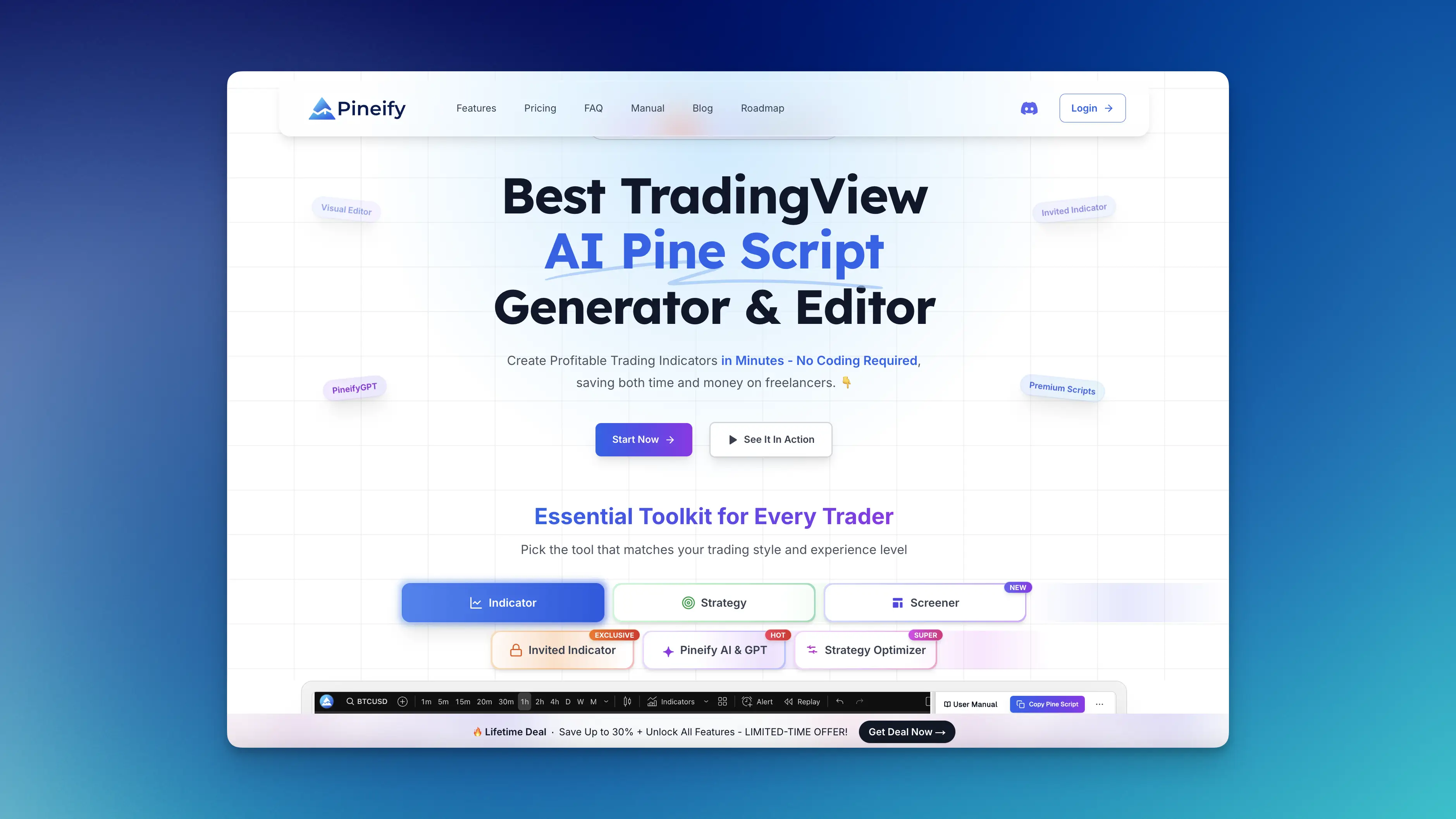
If you need to create custom indicators with specific alert conditions — say, combining a head and shoulders pattern with an RSI filter — tools like Pineify make it possible without writing Pine Script from scratch. With Pineify's visual editor, you can build indicators and strategies, set custom alerts, and backtest your ideas. One thing I'll flag: the visual editor has a learning curve for multi-condition logic, and I haven't had great results chaining more than four conditions together — the backtest outputs get hard to interpret.
Advanced Features and Benefits
Automatic Detection Eliminates Bias: When I scan charts myself, I definitely see patterns I'm hoping to find. This tool removes that. Its algorithm scans price action and gives you an objective read on what's forming.
Multi-Timeframe Capability: The indicator works across any timeframe. I check patterns on the daily chart first, then flip to the 4-hour and weekly to see if the same formation shows up. When it does, the signal is much stronger.
Clean Visual Presentation: It uses color-coded lines and shapes. Bullish and bearish signals are color-coded by default, and everything is labeled with the pattern's name and direction.
Focus on Significant Pivots: The ZigZag-based filtering ignores tiny price noise and focuses on major swing highs and lows. This cuts down false alarms compared to indicators that react to every wiggle.
Combining Chart Patterns with Other Trading Tools
Chart patterns work better when you pair them with other indicators. It's like getting a second opinion before you trade.
| Tool | How It Complements Chart Patterns |
|---|---|
| Relative Strength Index (RSI) | Confirms if a market is overbought or oversold. A bullish pattern forming when RSI is below 30 is a stronger signal. |
| Moving Average Convergence Divergence (MACD) | Gauges trend strength. Checks whether a pattern's potential move has lasting power. |
| Average True Range (ATR) | Measures volatility, which helps set sensible stop-loss and take-profit levels. |
| Volume Indicators | Confirms conviction behind a move. A breakout on high volume is more trustworthy than one on low volume. |
| Stochastic Oscillator | A momentum indicator that helps fine-tune entry timing. |
RSI (Relative Strength Index): Your go-to for spotting oversold or overbought conditions. If a double bottom shows up and RSI is below 30, that buy signal carries more weight. I use RSI with a 14-period setting on daily charts — my default since 2024.
MACD (Moving Average Convergence Divergence): Think of MACD as a trend's momentum check. If a chart pattern suggests an upward move but MACD is flat or pointing down, it could be a head fake. I've had good results filtering out head and shoulders signals when the MACD histogram is already negative and diverging — it saved me from at least three bad entries on SPY last quarter.
ATR (Average True Range): This one is about managing risk. ATR tells you how much an asset typically moves in a day, so you can place stop-loss orders a sensible distance away. For a swing trade on ETH/USD with the daily chart, I usually set my stop at 1.5x ATR below entry.
Volume Indicators: Volume confirms conviction. A breakout with low volume is suspect. The Volume Price Trend (VPT) indicator can show whether buyers or sellers are driving the action.
Stochastic Oscillator: Helps with timing. You might see a cup-and-handle forming, but the stochastic can tell you if price is poised to move now or might dip first.
Common Mistakes and How to Avoid Them
Even with automated tools, there are traps that eat into your profits.
Getting Faked Out: Some patterns are prone to false signals.
- Head and Shoulders: Misleading when volume is low.
- Triangles: A breakout often does not stick without a volume surge.
- Double Tops and Bottoms: Price can briefly poke through the neckline and snap back.
Always check volume and look for another indicator to confirm before you commit. Learning how to avoid repainting in Pine Script can also help you spot indicators that redraw their signals after the fact.
Forgetting the Big Picture: Patterns aligned with the dominant trend work better. Before I trade any pattern, I check the higher timeframe chart first.
Picking the Wrong Timeframe:
| Your Trading Style | Focus On These Timeframes | What to Keep in Mind |
|---|---|---|
| Day Trader | 5-min, 15-min | More patterns, but many need filtering. |
| Swing Trader | Daily & Weekly | Slower to form, more reliable moves. |
Trusting Bad Data: Gaps, slow feeds, or missing data can warp pattern detection — especially right at market open or during volatile periods.
Letting Automation Do All the Thinking: The indicator spots shapes. It does not know about earnings reports, news events, or shifts in market mood. Use it as a helper, not a decision-maker.
Practical Tips for Better Pattern Trading
I've been running this indicator daily since late 2025, and here's what has worked for me.
Save a Chart Template: Set up your preferred toggles and color scheme once, then save it as a template. Saves time and keeps analysis consistent. If you're working across multiple charts, Pineify's no-code builder helps compare setups side by side.
Cross-Timeframe Check: When the same pattern shows on the 1-hour, 4-hour, and daily charts, it's usually worth paying attention to.
Individual Alerts for Key Patterns: Since the composite indicator does not alert, add individual pattern indicators for your top 2-3 setups. I keep "Head and Shoulders" and "Flag" indicators running with price alerts.
Combine Confirming Patterns: A head and shoulders completing at the same level as a triangle breakdown gives more confidence than either alone.
Check Price Action on the Breakout: A bullish engulfing candle with high volume at the breakout point is a strong second confirmation.
Protect Your Capital: Patterns fail. I risk no more than 1-2% of my account on any single trade, and I always use a stop-loss placed logically based on the pattern's structure.
Frequently Asked Questions
Is the all chart pattern indicator free on TradingView?
Yes, it's free on any TradingView plan, including the free tier. Open the indicators menu, search for "All Chart Patterns," and add it. No extra charge.
Can I use this indicator for cryptocurrency trading?
Definitely. I've used it on Bitcoin, Ethereum, and Solana charts. The same human psychology of fear and greed drives price action across stocks, crypto, forex, and commodities — so the patterns show up everywhere. That said, crypto's higher volatility means more false signals on short timeframes.
How reliable are automated chart pattern indicators?
Reliability depends on timeframe, volume, and trend alignment. Patterns on daily or weekly charts tend to be more trustworthy than ones on 5-minute charts, but you'll see fewer of them. I trust a pattern a lot more when it's backed by strong volume and aligned with the higher timeframe trend. Most experienced traders use these patterns as one piece of a bigger strategy, not as a standalone signal.
Does the all chart pattern indicator provide trading signals?
Not exactly. It's a pattern spotter — good at identifying formations and calculating targets, but it leaves the buy or sell decision to you. You still need your own analysis, additional indicators, and solid risk management.
Can I customize which patterns the indicator displays?
Yes, and this is one of its best features. The settings let you toggle each pattern type on or off. If you only want head and shoulders and flags, hide everything else. You can also choose between showing every historical pattern or only the most recent one.
What is the difference between the All Chart Patterns indicator and individual pattern indicators?
The composite indicator packs many patterns into one tool, keeping your chart clean. Individual pattern indicators give you more detailed settings per pattern and usually support alerts. My approach: use the composite for a broad scan, then add individual indicators for the 2-3 patterns I trade most.