Track NVDA Options Flow: Follow Institutional Trading Signals

NVIDIA is a favorite playground for big-money traders. On any given day, over 258,000 options contracts change hands on NVDA. That torrent of activity isn't just noise—it's a direct look at how hedge funds, institutions, and seasoned investors are betting on this defining AI company.
If you're trading NVDA, whether in and out in a day or planning a longer swing, learning to read this options flow can give you a serious advantage.
NVDA options flow is the live feed of big, unusual options trades happening across all the exchanges. When a major player makes a sizable bet on NVIDIA, that trade gets reported as part of the flow. This matters because institutional traders leave footprints in the options market before major price moves happen.
For NVDA this is especially important. Every single day, billions of dollars in options premiums are tied to where traders think the stock is headed next. This frenzy comes from earnings reports, new AI chip demand, and broader economic shifts.
By paying attention to this flow, you can start to piece together clues about the market's mood:
- Bullish or Bearish? Are the big trades mostly calls (betting up) or puts (betting down)?
- How Strong Is the Conviction? Is it a small, cautious trade or a massive, high-cost bet?
- What's the Timeframe? Are traders buying options expiring this week (quick move) or years out (long-term trend)?
- Is a Big Move Expected? Are traders paying up for options, suggesting a major swing is coming?
As of April 10, 2026, NVDA trades at $189.90, with over 72 million shares traded. The company's $4.6 trillion valuation is why its options activity is watched so closely by traders everywhere.
How Options Flow Gets Classified
It comes down to one question: how badly did someone want the trade to happen? The key isn't just what was traded, but how it was traded relative to current prices. Every trade gets sorted into one of three buckets based on urgency:
| Classification | What It Means | Signal |
|---|---|---|
| Above Ask | The buyer paid more than the lowest advertised selling price. | Strongly Bullish |
| Below Bid | The seller accepted less than the highest advertised buying price. | Strongly Bearish |
| At Mid | The trade filled in the middle, often a direct negotiation. | Neutral / Institutional |
If someone is buying NVDA calls above the ask, they're saying, "I don't care about the extra cost, I need these contracts right now." That urgency is a powerful clue about conviction.
Sweep vs. Single Trade
Execution strategy tells another story.
A sweep is like a blitz. A large order gets split and sent to multiple exchanges at once. The goal is to scoop up all available contracts before anyone notices and the price moves. When I see sweeps for out-of-the-money NVDA calls right before a big event like earnings, it's often a tip-off that a big player is making a rapid, calculated bet. I've found these sweeps are most reliable when they cluster above $500,000 in premium.
A single-leg block trade is more methodical. It's a large order executed quietly on a single exchange. This usually points to a planned, strategic position—less about speed and more about precise positioning.
Understanding the Data in an NVDA Options Flow Feed
When you pull up a live feed of Nvidia's options activity, it can feel like a waterfall of numbers and codes. Don't let it overwhelm you. Focus on a few key data points that tell the real story:
- Premium (Total Cost): Multiply contracts by the price per contract, then by 100. A single trade over $500,000 gets my attention. When it crosses $2 million, it's often a sign that a big player is making a move.
- Volume vs. Open Interest: If volume for a specific option is much higher than existing open interest, traders are likely opening brand new positions. I pay closer attention to those than to trades adjusting existing positions.
- Strike & Expiry: The strike price shows where the trader thinks the stock is headed. The expiration date reveals their timeline. Far-out expiration suggests a patient outlook. Near-term expiry is a play on an immediate move.
- Implied Volatility (IV): High IV means the market expects a big swing. For NVDA, this spikes before earnings. It tells you traders are pricing in uncertainty and potential for a major move.
- Delta: Think of delta as the option's sensitivity to the stock price. A call with a delta of 0.70 or higher moves almost in lockstep with the underlying stock. That's a high-conviction directional bet.
- Trade Type: Was it a single trade, a sweep, or a split? A sweep across multiple exchanges signals urgency and institutional buying power. A single trade might be less time-sensitive. I haven't tested every options flow tool on the market, but Pineify's feed catches these sweeps in under a second, which I've found useful for getting ahead of mainstream coverage.
Putting Theory into Practice with Pineify
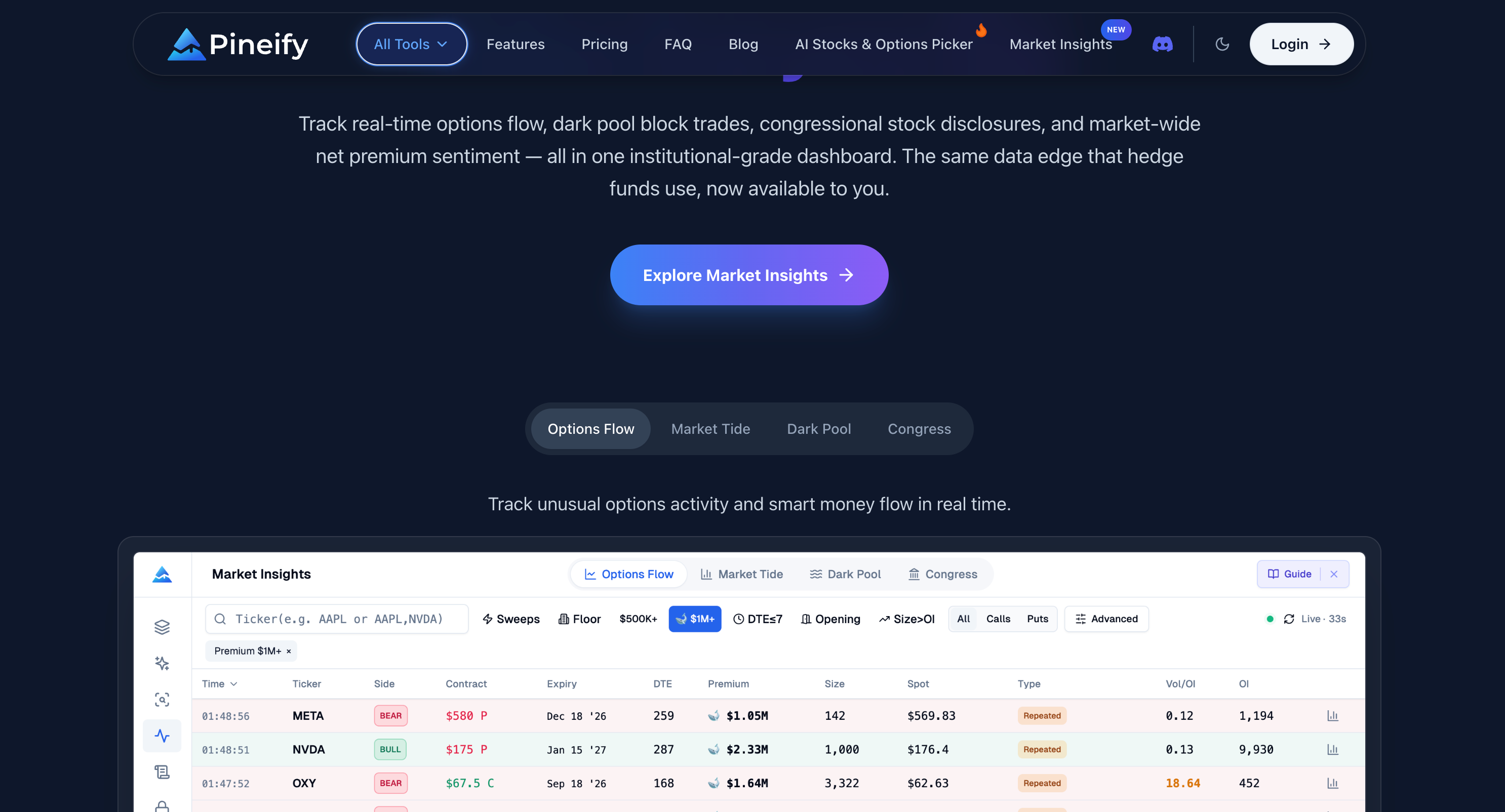
Understanding these data points is one thing. Having a tool that surfaces and organizes them in real-time is what separates guesswork from informed action. This is where Pineify comes in. Its Market Insights dashboard aggregates live options flow, dark pool prints, and institutional activity into a single view. Instead of manually deciphering raw feeds, you can spot unusual activity in NVDA instantly—like multi-million dollar sweeps or IV spikes—and see broader market sentiment through net premium heatmaps. It gives you an institutional lens to interpret the data, helping you act on signals before they become mainstream news.
How to Track NVDA Options Flow with Pineify
If you want a read on what smart money is doing with NVDA, watching the options market is key. Pineify Market Insights brings together all the signals—live options trades, dark pool moves, political trading disclosures, and overall market mood—into one clean dashboard.
Pineify tracks over 50,000 options trades every single day, and data hits your screen in under a second. You're seeing the same flow information that institutional trading desks use.
For NVDA, the platform shows:
- A live feed of significant NVDA trades, highlighting big-money activity.
- Automatic sentiment tags (Bullish or Bearish) on each trade, based on whether they happened above ask or below bid.
- Powerful filters by ticker, minimum dollar amount, sentiment, trade type, and expiration.
- A full Greeks breakdown for any trade—click to see Delta, Gamma, Theta, Vega, and implied volatility.
- Custom alerts for unusual activity based on your premium thresholds.
The Market Tide feature acts like a market-wide weather vane. It shows whether more money flows into calls or puts across the entire options market. This helps you see if NVDA's positive flow is part of a broader uptrend or going against a cautious current.
How Dark Pool Data Confirms NVDA Options Flow
You see a big wave of call buying in NVDA options. It's tempting to jump on that signal. But there's a way to check if institutions are also making the same move behind the scenes—by looking at dark pool data.
Dark pools are private trading rooms for institutions. When a mutual fund or pension fund wants to buy or sell a huge block of NVDA without tipping off the market, they do it there. Nearly 40% of all stock trading happens in these off-exchange venues.
So if you see aggressive call buying in options flow and massive blocks of NVDA stock being bought in dark pools at the same time, that's a stronger signal. It means the smart money isn't just betting with options—they're accumulating the actual stock.
Pineify's Dark Pool Tools
Our Dark Pool Intelligence module tracks every private trade for NVDA:
- Block and Mega Block trade alerts, sorted by size.
- Buy/Sell direction inference using public bid and ask prices at the moment of the trade.
- Volume profile visualization showing where the heaviest institutional trading is happening at each price level.
- Point of Control (POC) markers to spot the single price where the most shares have traded—often a key level for institutions.
When your options flow scanner lights up with NVDA call buys and dark pool data shows heavy block buying clustering at the same price level, you have two separate signals pointing in the same direction. That convergence—between the options market and the private institutional stock market—is where high-conviction ideas come from.
How to Use NVDA Options Flow by Trading Style
Options flow on a stock like NVDA can feel overwhelming. But it's really about seeing what other traders—especially the big, well-researched ones—are doing with their money. Here's how different traders can use this information:
For the Day Trader
Focus on the first hour of the market. That's when the day's story often gets written. Watch the options flow feed during this window. If large, unusual NVDA call orders fill quickly above the asking price, it can signal building momentum.
Before jumping in, check the broader tech sector. Is money flowing into tech overall? If the sector is green with positive flow, the NVDA move might have legs.
For the Swing Trader (Days/Weeks)
Look for patterns over several days. Pay attention to options expiring in one to two weeks with heavy premium changing hands. The key is spotting clusters.
If you see significant trades piling up at the same strike price and expiration for NVDA across multiple sessions, bigger players might be positioning for an event. I've had better luck when I also check whether large off-exchange stock purchases align with these clusters—the confirmation tightens the thesis.
For the Options Specialist
This is where details matter. Each options flow print shows the Greeks, revealing the trade's risk profile. I look at these to guess what the person placing the trade is thinking.
- Example 1: A call with a low delta (0.30) and three weeks until expiry is cheap, speculative leverage. The trader is likely buying a cheap chance at a big breakout.
- Example 2: A call with a high delta (0.80) expiring in two days is expensive and moves almost dollar-for-dollar with the stock. This is a pure, high-conviction directional bet.
Match the personality of the flow to your own strategy. It helps refine your timing.
| Trader Type | Key Focus in the Flow | What to Pair It With |
|---|---|---|
| Day Trader | Unusual call sweeps in the first trading hour. | Overall tech sector momentum. |
| Swing Trader | Clusters of activity at a specific strike/expiry over days. | Large, off-exchange (dark pool) stock purchases. |
| Options Trader | The Delta and expiry of each large trade to gauge intent. | Your own thesis on direction and timing. |
Pineify vs. Other NVDA Options Flow Tools
When you're trying to understand what smart money is doing with Nvidia, not all options flow tools are built the same. Here's a straightforward look at how Pineify stacks up against other popular services.
| Feature | Pineify Market Insights | Unusual Whales | FlowAlgo | Barchart |
|---|---|---|---|---|
| Real-Time Options Flow | ✅ | ✅ | ✅ | ✅ Premier |
| Dark Pool Analysis | ✅ Full | ✅ Basic | ❌ | ❌ |
| Market Tide / Net Premium | ✅ Sector-level | ❌ | ❌ | ❌ |
| Congress Trading Tracker | ✅ Full | ✅ Basic | ❌ | ❌ |
| Unified Dashboard | ✅ All-in-one | Partial | Single focus | Single focus |
| AI Finance Agent | ✅ | ❌ | ❌ | ❌ |
| Pine Script Tools + Backtester | ✅ | ❌ | ❌ | ❌ |
What sets Pineify apart isn't just the feature list. It's how everything works together.
Other tools give you a piece of the puzzle—options flow alone. Pineify connects the dots: live options activity, dark pool data, Congress trading disclosures, and broader market sentiment on one screen. You see the whole story, not just a chapter. This integrated approach is what makes Automated Trading in TradingView: Complete Guide to Strategy Automation so powerful.
Plus, the built-in AI assistant and Pine Script tools let you test ideas and get insights in plain English, all in one platform. You don't need five different tabs.
One limitation I should mention: Pineify's options flow is complete but it doesn't cover every single exchange's pre-market activity. If you depend heavily on pre-market data, you may want to supplement with a dedicated pre-market scanner.
Q&A: Understanding NVDA Options Flow
Q: What does it mean when NVDA sees unusual options activity? Think of unusual options activity like a sudden loud conversation in a quiet room. Trading volume for a specific Nvidia option spikes far above its recent average, often with large money changing hands in one go. That usually means a big trader—a hedge fund or experienced individual—is making a major move, positioning for a significant price swing.
Q: Can I rely on NVDA options flow alone to make trading decisions? Not really. Options flow is a great clue but not the full story. Big traders use complex strategies. What looks like a bullish bet might be one piece of a larger hedged position. Use options flow as a starting point, then check dark pool data and overall market sentiment before you make a move. For risk management, the Ulcer Index: How to Measure Trading Pain and Risk in TradingView is worth understanding.
Q: When is the best time to check NVDA options flow? Depends on your style:
- Day Traders: Watch it throughout the day.
- Swing Traders (days/weeks): Focus on the first and last hour. That's when big players open and close their major positions.
Q: Is there a free way to track NVDA options flow? Yes. Pineify has a free Options Flow Summary tool covering NVDA and 15+ other stocks. If you need real-time data, deeper filters, or dark pool integration, they offer a premium plan.
What to Do Next: Start Watching NVDA Options Flow
If you're trading Nvidia, knowing where the big, sophisticated money is going makes a real difference. That kind of move often shows up in the options market before it fully hits the stock price. With Nvidia's options trading so active, tracking this flow is incredibly useful.
Getting started is straightforward:
- Head over to Pineify Market Insights and check the live Options Flow tool.
- Filter for NVDA with a minimum trade value of $100,000 or more. This filters out retail noise and focuses on institutional blocks.
- Check the broader market with the Market Tide gauge. See if overall sentiment aligns with or contradicts what Nvidia's options show.
- Review Dark Pool data for NVDA. This reveals price levels where large share blocks trade off-exchange, hinting at institutional positioning.
- Check Congress Trading disclosures for lawmakers trading Nvidia or related semiconductor companies.
- Combine the signals. The strongest ideas come from multiple data points lining up—unusual options flow, supportive sentiment, and dark pool activity at the same price level.
This multi-layered data is what professional firms use. Now it's available in a single platform. If you're building custom indicators to complement this analysis, a Pine Script AI Coding Agent: Essential for TradingView Automation can speed up your workflow significantly.
What is NVDA options flow and why does it matter?
NVDA options flow is the real-time feed of large options trades on Nvidia stock across all exchanges. It matters because institutional traders leave footprints in the options market before major price moves. By tracking this flow, retail traders can spot unusual activity—like sweeps above the ask price—that often precedes meaningful moves in NVDA stock.
How do I identify institutional trading signals in NVDA options?
Look for trades with premiums above $500,000, especially sweeps crossing multiple exchanges. Signals are stronger when volume exceeds open interest (new positions), when trades occur above the ask (aggressive bullish conviction), and when options activity aligns with dark pool block trades at similar prices. Combining these signals is more reliable than any single data point.
What is the difference between a sweep and a block trade in options flow?
A sweep splits a large order across multiple exchanges to fill quickly before prices move—it signals urgency and aggressive positioning. A block trade is a single large order on one exchange, more deliberate. Sweeps above the ask on NVDA calls suggest urgent bullish conviction; block trades hint at strategic institutional planning.
How does dark pool data confirm NVDA options flow signals?
Dark pool data shows large off-exchange share purchases that institutions make to avoid moving the market. When aggressive call buying in NVDA options flow aligns with large block purchases in dark pool data at similar prices, that convergence is a stronger signal than options flow alone. It means institutions are simultaneously buying stock and call options—a high-conviction bullish setup.
What premium threshold should I use when filtering NVDA options flow?
Start with a $100,000 minimum to filter out retail trades. Trades above $500,000 indicate serious positioning. Those crossing $2 million often represent major institutional moves. For day trading, filter for same-day expirations. For swing trading, focus on one to two week expirations with high premium at specific strikes.
Can options flow analysis predict NVDA earnings moves?
Options flow can't predict outcomes, but it reveals how smart money positions before earnings. Watch for IV spikes, large sweeps on out-of-the-money calls or puts in the days before earnings, and whether net premium skews bullish or bearish. Clusters at specific strikes indicate where institutional traders expect the stock to move.
What tools are best for tracking NVDA options flow in real time?
Pineify Market Insights tracks 50,000+ options trades daily with sub-second delivery, combining live options flow, dark pool intelligence, and market sentiment in one dashboard. It offers sentiment tagging, Greeks breakdowns, custom alerts, and a Market Tide feature showing net premium flow across the market. This integrated approach lets you cross-reference NVDA signals with broader institutional activity without switching platforms.