Mastering the Blue Sky Day Script on TradingView

· 16 min read

The Blue Sky Day script on TradingView is a favorite tool for many traders in the forex and stock markets. It's known as a no-repaint indicator, which basically means the signals it gives you don't change after the fact. This guide will walk you through how it works, how to set it up, and simple ways to use it to help inform your trading decisions.

Mastering the Blue Sky Day Script on TradingView

Getting to Know the Blue Sky Day Script

Think of the Blue Sky Day script as a reliable assistant that spots potential buy and sell opportunities for things like currency pairs and stocks. It works really well in active markets, like trading the EUR/USD or GBP/USD, by giving you clear short or long signals along with expected targets. The best part? The signals stay the same even if you refresh your chart, so you can trust what you see.

Built for serious trading, it's become popular because it handles fast-moving markets so well. The core of its reliability comes from its non-repainting nature. Once a signal appears on your chart, it's locked in and won't disappear or move. This makes it incredibly trustworthy when you're looking back at past data to test a strategy.

Unlike some older indicators that can shift and change, what you see with Blue Sky Day is what you get, whether you're looking at a 15-minute chart for GBP/USD or a different timeframe. Many traders like to pair it with other tools, like simple trend lines, to get a second opinion before making a move. For traders looking to expand their toolkit, understanding Pine Script input options can provide deeper customization of your indicators.

Getting Blue Sky Day Set Up on TradingView

Getting the Blue Sky Day script running on your TradingView chart is pretty straightforward. Think of it like adding any other indicator—it only takes a moment. Here's how to do it, step-by-step.

Step 1: Open the Indicators Menu On your TradingView chart, look for the "Indicators" button at the top. It usually says "FX" on it. Click that.

Step 2: Find the Script In the search bar that pops up, type in "Blue Sky Day No Repaint." The right script should appear in the results. Just click on its name to add it directly to your chart.

Step 3: You're Done! That's it. The script will load onto your chart and start showing signals right away. No complicated setup or coding needed.

Tweaking the Settings for Your Trades

Once it's on your chart, you can adjust the settings to fit what you're trading. For example, if you're looking at a forex pair like EUR/USD, you might want one setting, while a stock like NSE:INFY might work better with another. The script is flexible, so don't be afraid to play with the inputs in the settings menu to see what looks best for your strategy.

A Quick Tip for Testing

A good habit is to refresh your chart after you add the script. This helps you confirm that the signals you see are solid and don't change after a new candle closes—that's the "no repaint" feature in action. You can watch the signals for a pair like GBP/USD to see if they stay put.

Before You Go Live

It's always smart to test things out first:

  • Use a demo account to see how the signals perform in different market conditions.
  • Consider pairing the script with other tools you trust, like a moving average, to help confirm the signals.
  • Make sure you're using an up-to-date version of TradingView for the best experience.

Taking a little time to test on a demo account first helps you get comfortable with how it works and builds confidence before you use it with real money.

Key Features of Blue Sky Day

One of the things that makes this tool so reliable is its no-repaint feature. This means that once a trading signal appears on your chart, it won't disappear or change later. You can trust the signal you see, which is a huge help when you're trying to make fast decisions in a choppy market. It gives you clear entry points and even shows you potential profit targets. For example, it might pinpoint a target of 1.30404 for GBP/USD right on your 15-minute chart.

What's really handy is that it isn't just for one market. You can use it for forex, stocks, and commodities, so it fits right into whatever you're trading. It also plays nicely with other tools you might already use, like the RSI or your own trend lines. This combo has worked well for trades on stocks like AMD or APOLLOHOSP, and it's known to be effective on a wide range of active trading pairs. If you're interested in exploring other powerful indicators, you might want to check out this comprehensive guide on the Ehlers Dynamic Smoothed Moving Average Indicator for TradingView Pine Script.

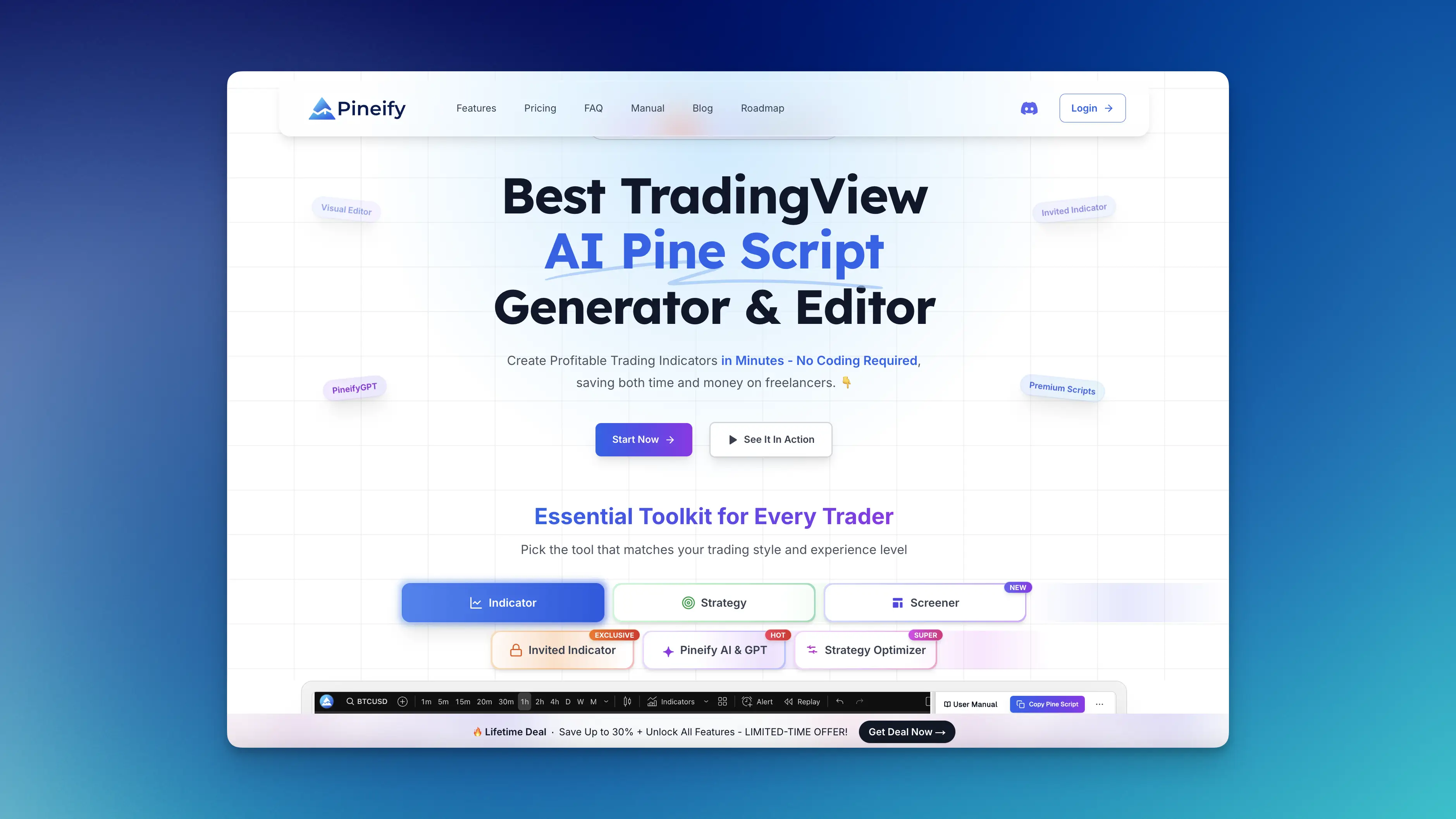
Pineify Website

Speaking of trading tools, if you're looking to create your own reliable indicators like this without any coding, platforms like Pineify make it incredibly accessible. Their visual editor lets you build custom indicators and strategies in minutes, combining multiple technical indicators just like the professional tools do.

FeatureBenefitExample
No-Repaint SignalsSignals stay put, providing reliabilityConfident entries on volatile days
Projected TargetsClear profit-taking levelsTarget of 1.30404 on GBP/USD M15
Multi-Asset SupportWorks across different marketsForex, Stocks (e.g., AMD), Commodities
Indicator CompatibilityEnhances existing strategiesCombines well with RSI, trend lines

Plus, it has a built-in alert system to let you know when a trade is setting up for a potential profit, like waiting for that final confirmation on a EUR/AUD move. Because it aligns with other technical gauges like oscillators and pivot points, you get a really well-rounded view of the market. All these things together just make for a much smoother and more confident trading experience.

Trading Strategies with a Blue Sky Day

A straightforward way to use this is to look for buy signals when the price is already above a key level. For example, you might plan to buy a stock like INFY only if it moves above 960.20, with a goal of it reaching 977. The important part is to always have a stop-loss order placed just below a nearby support line. This helps you manage your risk and makes sure your trades are generally going with the overall market trend. It's a solid approach that works for both stocks and forex, and it really emphasizes waiting for that signal confirmation before jumping in.

If you're more experienced, you can combine the Blue Sky Day concept with Elliott Wave analysis. This is great for targeting strong momentum moves, like those you often see in indices such as the SPX or Nifty. The idea is to set your buys closer to the current price, aiming for upside moves in the 5-11% range, and using a red trend line on your chart as your stop-loss point. Blending these methods can be really powerful for spotting potential reversal areas.

For quick, intraday trading, you can use the script almost like a screener to find stocks showing relative strength—similar to how RS/RW screeners work on TradingView. You can sort the top performers based on the signals to quickly spot which stocks are leading the pack, and this can be adapted for both daily and very short-term timeframes. Just remember to double-check with volume indicators for that extra layer of confirmation.

No matter which strategy you use, risk management is the most crucial part. Let's say you're looking at Apple; you might decide to buy at 381.12, aiming for a 3% gain with a very tight stop-loss at 0.62%. Pairing this with an indicator like the RSI can help you see if there's still room for the upward momentum to continue. This kind of disciplined approach helps keep your losses small while letting you take advantage of those clear "blue sky" opportunities.

Real-World Examples and Case Studies

Let's look at how this plays out in actual trading. It's one thing to talk about a strategy, but seeing it in action makes all the difference.

Forex: GBP/USD On a 15-minute chart, the system flagged a short trade on GBP/USD, pointing to a target of 1.30404. The cool part? The pair moved down just as expected, and the signal stayed solid without disappearing or "repainting." This is a great example of the tool working reliably in the fast-paced forex market. Traders who used this signal mentioned they found good entry points right when the pair was hitting session highs.

Stocks: NSE:INFY For a stock like INFY (Infosys), it gave a buy signal when the price moved above 960.20. The trade then went on to hit its targets between 965 and 977. The smart move here was using a stop-loss placed below 946, which protected their capital if the price had turned down. This shows how the script can be effectively used for stocks in the Indian market.

Indices & Other Assets When trading indices like Bank Nifty or a stock like Bajaj Finance, the tool provided clear signals that had good follow-through. This really cut down the time spent on analysis. Some users also tried it on a stock like AMD, combining its signals with other trusted indicators to find efficient entry points. These cases show its practical use across different types of assets—from indices to equities.

Another Forex Example: EUR/USD During an analysis of EUR/USD, the system noted that highs were forming near 1.1920. It then identified a breakout that was targeting the 1.1996 level. What was helpful was that these signals matched up with key market levels (pivot points), which made it easier to anticipate corrective price moves. Seeing it work in real-time like this really helps build trust in its reliability.

The Real Deal: Strengths and Things to Keep in Mind

So, what's the big appeal? For starters, the signals this tool generates are "non-repainting." In plain English, that means once a signal appears on your chart, it stays put. It won't magically disappear later. This is a huge deal for backtesting your strategies because you can trust that what you're seeing is what actually happened, making your tests much more valid. It's a professional-grade feature that's surprisingly free on TradingView and works on all sorts of assets, from stocks to forex, which really opens up advanced analysis to everyone.

Of course, no tool is perfect. You might find that in quieter, less volatile markets, the signals can become less frequent. During those calm periods, it's a good idea to have another indicator or two in your toolkit to get a full picture. There are also some technical limits within TradingView's own scripting language, Pine Script, that can make it tricky to create certain multi-timeframe setups, something you might notice if you've ever dabbled with Relative Strength screeners.

The key takeaway? Don't use it in a vacuum. It's incredibly powerful, but you'll get the best results if you combine it with an understanding of the overall market context and perhaps a volume-based indicator. For active traders, the benefits definitely outweigh the limitations, especially since the tool is continually refined to stay effective. Just remember to use it as a part of your process, not as a crystal ball. If you're interested in learning more about advanced Pine Script techniques, our Multi-timeframe (MTF) Pine Script Guide covers how to work across different timeframes effectively.

AspectThe UpsideThe Consideration
Signal ReliabilityNon-repainting signals ensure honest backtesting.Signals can be less frequent in calm, low-volatility markets.
AccessibilityFree on TradingView and easy to learn with available guides.Platform constraints can limit complex multi-timeframe analysis.
Overall UseA robust, free tool that's great for active traders.Works best when combined with other tools and market knowledge.

Find Your Trading Edge with the Blue Sky Day Script on TradingView

Ever feel like the markets are just noise? What if you had a tool that helped you spot those perfect, clear-trending days? That's the idea behind the blue sky day script TradingView strategy. It's all about identifying those moments when a stock breaks free from the clutter and is poised for a strong move.

Let's break down how you can use this to your advantage.

What Makes a "Blue Sky Day"?

Think of a blue sky day in trading like a perfect, sunny day with no clouds in sight. In market terms, it's when an asset's price breaks decisively above a recent area of consolidation or resistance. There's no old price history overhead—just clear, open space for it to run.

This script on TradingView helps automate the process of spotting these setups, so you don't have to stare at charts all day.

Getting Started with Your Blue Sky Day Script

Here's a simple way to get set up:

  1. Log in to TradingView: Head to their website and open up the charting platform.
  2. Open the Pine Editor: This is where you'll paste or write your script.
  3. Implement Your Strategy: Whether you're using a community script or coding your own, the goal is to visually highlight these breakout conditions.

The real power comes from combining this script with other sound trading principles.

Why a No Repaint Indicator is Crucial

One of the biggest headaches in trading is a "repainting" indicator. This is when an indicator looks back and changes its past signals. A signal that was there an hour ago might suddenly vanish, making your analysis completely unreliable.

This is why seeking out a no repaint indicator is so important. You need to trust that the buy or sell signal you see on the chart is fixed and won't change after the fact. A quality blue sky day script should be built on non-repainting logic, giving you confidence in the alerts it generates.

A Simple Checklist for Your Blue Sky Day Trades

Don't just rely on the script alone. Use it as part of a bigger picture. Before entering a trade, run through this quick list:

  • Is the overall market trend in your favor? (e.g., Uptrend on a higher time frame)
  • Has volume confirmed the breakout? Look for higher-than-average volume on the breakout candle.
  • Where is your logical stop-loss? A good place is often just below the recent consolidation area.
  • What's your profit-taking plan? Having a target in mind beforehand helps you lock in gains.

Putting It All Together

The blue sky day script TradingView tool is a fantastic starting point for finding high-probability trades. By focusing on clean breakouts and ensuring your tools are built with a no repaint indicator foundation, you filter out a lot of the market noise. If you're looking to validate your strategies, learning how to backtest on TradingView can significantly improve your trading edge.

Next Steps & Sharing: Did you find this breakdown helpful? The best way to solidify your knowledge is to apply it. Go test these concepts on a TradingView chart with a demo account. If this guide helped you see the charts more clearly, please consider sharing it with a fellow trader. Sharing insights helps everyone grow.

Your Blue Sky Day Script Questions, Answered

What exactly is the Blue Sky Day script on TradingView?

Think of the Blue Sky Day script as your trading co-pilot. It's a popular indicator that spots potential trading opportunities in markets like forex and stocks. The best part? It's a "no-repaint" indicator, which is just a fancy way of saying that once it gives you a signal, it won't disappear or change later. What you see is what you get, making its alerts pretty reliable.

How do I get the Blue Sky Day script on my chart?

Getting started is super simple. Just head over to the "Indicators" section on TradingView and search for "Blue Sky Day." Click "Add to Chart," and you're almost done. From there, you can tweak the colors and settings to your liking. If you're more of a visual learner, there are plenty of quick video guides out there that walk you through the whole process.

I'm new to trading. Is this a good tool for me?

Absolutely. Its straightforward design is one of the reasons beginners love it. Plus, it's free to use. A good tip is to not rely on it alone—pair its signals with other basic tools you're learning, like drawing trend lines. And as always, it's a smart move to test everything out in a demo account first before using real money.

Can I use this for trading cryptocurrencies like Bitcoin?

While it was built with forex and stocks in mind, there's nothing stopping you from using it on crypto charts for assets like Bitcoin. It uses classic technical analysis, which applies to any market. Just keep in mind that crypto can be extra volatile, so you might need to adjust your approach accordingly.

What are some common slip-ups people make?

The biggest mistake is putting all your trust in this one tool. It's a fantastic helper, but it's not a crystal ball. Don't forget to use other confirmation tools and, crucially, always set a stop-loss. Before placing a trade, take a quick second to check the overall market conditions—is there major news? Is the overall trend strong? A quick sense-check can save you from unnecessary losses.

Your Next Moves with the Blue Sky Day Script

Ready to give it a go? The best way to start is by installing the Blue Sky Day script on TradingView and taking it for a spin on a demo account. Pick your favorite assets and see how it feels without any real-world pressure.

Once you've played around with it, jump into the conversation. Share what you've noticed in TradingView's communities or drop a comment below. Did you find a cool way to use it? Your experience could be the "aha!" moment for someone else.

If you're getting comfortable, you can level up by pairing the script with other tools, like Renko charts or volume indicators, to see the full picture. For those testing it on popular pairs like EUR/USD, let us know how it went—what targets did you manage to hit?

Staying engaged like this is a fantastic way to deepen your own understanding and become a recognized part of the community.