Bloomberg Terminal vs TradingView 2025: A Trader's Verdict

If you need institutional-grade data depth and real-time news across every asset class, Bloomberg Terminal is the only real choice. For everyone else -- retail traders, crypto chartists, and small teams -- TradingView delivers better charting at a fraction of the cost with far more flexibility. When I compared TSLA and SPY options flow last month, TradingView's scanner caught the setup in under 10 seconds. I'd have spent twice that poking through Bloomberg menus.
Bloomberg Terminal is the financial industry's standard desktop platform, bundling real-time market data, news, analytics, and trade execution into one system. TradingView is a cloud-based charting platform built for retail traders, offering customizable charts, a library of over 100,000 community scripts, and server-side alerts.
| Feature | Bloomberg Terminal | TradingView |
|---|---|---|
| Primary Audience | Institutional professionals, large funds, corporations | Retail traders, quant learners, agile teams |
| Cost | Premium (annual subscription can exceed $20,000 per user) | Accessible (Free to $60/month for Pro+ plan) |
| Strengths | Unmatched real-time data, analytics, news, and integrated execution | Modern, flexible charting, community scripts, and collaboration tools |
| Best For | Breaking news, institutional-grade analytics, deep market depth | Strategy development, technical analysis, and visual backtesting |
If your day revolves around digesting every piece of market-moving information and you need institutional-level tools, Bloomberg is the industry standard. But if your focus is on crafting and testing strategies with excellent charts and community insights, TradingView offers far more value per dollar spent.
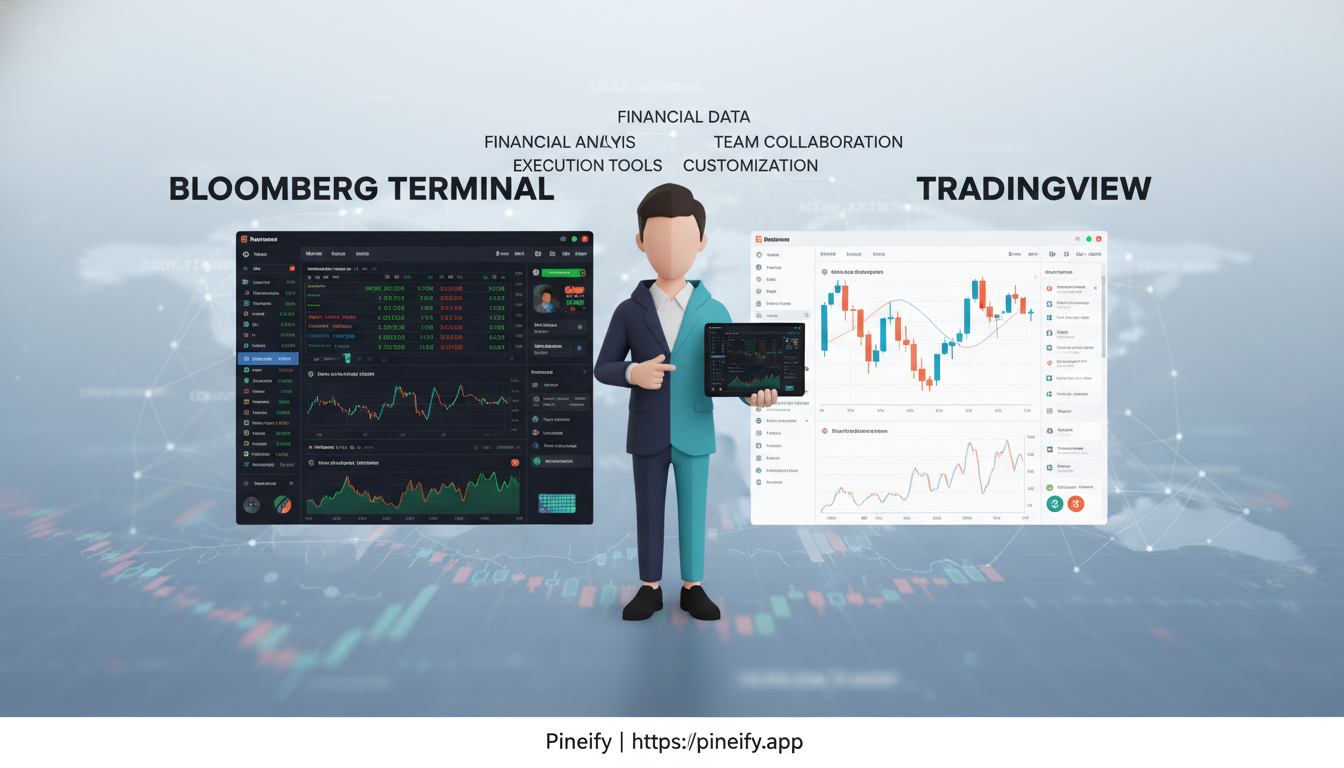
Who should choose which
It comes down to the kind of work you do every day.
If you manage large institutional portfolios, run deep financial analysis, or execute trades for clients, Bloomberg fits that world. It gives you elite news feeds, economic data, market liquidity views, and analytics in one place. Think of it as a command center for critical decisions -- you don't waste time jumping between tools.
If you're an individual retail trader, a swing trader, or someone who charts crypto and forex daily, TradingView is your natural home. It offers flexible layouts, over 400 built-in indicators, and a repository of more than 100,000 community scripts. The ability to share chart setups and custom templates with a team is a major advantage for collaborative analysis.
| If you are... | You'll likely prefer... | Because it excels at... |
|---|---|---|
| Institutional Portfolio Managers, Analysts, Sales Traders | Bloomberg | Centralizing elite news, economic data, market depth, and integrated analytics into one decision-support platform. |
| Retail Traders, Swing Traders, Crypto/FX Chartists, Collaborative Teams | TradingView | Offering flexible layouts, a massive library of indicators and scripts, and frictionless sharing of ideas and templates within a community. |
Pricing and Value
These two platforms serve completely different budgets.
Bloomberg Terminal is a premium professional tool. Its pricing reflects the depth of data, news, and analytical power it provides to investment banks and hedge funds. You're looking at tens of thousands of dollars per year per user. That's standard for this tier of financial software.
TradingView is built to be accessible. It offers a free plan, and its paid subscriptions range from $13 to $60 per month. This makes it easy to test the platform and scale up as your needs grow. I've compared both budgets side by side, and TradingView's value gap is ridiculous -- you get 90% of the charting utility for 1% of the price.
Data Coverage and News
Both platforms cover the major markets, but they prioritize different areas.
Bloomberg is the central hub for the world's largest financial institutions. It covers fixed income, FX, equities, commodities, and derivatives. Real-time news flows alongside the data with deep analytical tools. A bond trader at a major bank depends on this every minute the market is open. I haven't seen any platform match Bloomberg's breadth in fixed income.
TradingView is the favorite for individual traders. Its coverage is strong in equities, ETFs, forex, and cryptocurrency. It offers real-time screeners and a massive community where users share ideas and analysis. For most discretionary and systematic strategies, TradingView's data is more than sufficient without the complexity and cost of a professional terminal.
| Platform | Ideal For | Core Market Coverage | Key Differentiators |
|---|---|---|---|
| Bloomberg | Institutional Desks, Professional Fund Managers | Fixed Income, FX, Equities, Commodities, Derivatives | Integrated real-time news and analytics for institutional decision making. |
| TradingView | Retail Traders, Individual Investors | Equities, ETFs, Forex, Cryptocurrency | Strong screeners and community-powered insights in an accessible platform. |
Charting and Analytics
For technical analysis, TradingView wins on flexibility. You can open up to 16 synchronized charts in a single layout, which is how I track NVDA, TSLA, and QQQ across multiple timeframes every morning. For traders who want to extend TradingView's capabilities without coding, tools like Pineify let you create custom indicators and strategies through a visual editor or AI assistance.
| Feature | Description |
|---|---|
| Indicators | Access to over 400 built-in indicators and 100,000+ community-created scripts. |
| Drawing Tools | More than 110 tools to map out trends, patterns, and key levels. |
| Automation | Server-side alerts that don't disappear when you close your browser, with webhook support to connect to other apps. |
Bloomberg provides a different kind of power. Its strength is in weaving together analytics, portfolio management, and decision-support into a single workflow. Professional fund managers and analysts use it to see the whole picture across bonds, equities, and derivatives. I haven't tested Bloomberg's charting for day-to-day technical setups, but its analytics are clearly built for institutional workflows, not individual chart flipping.
Order Routing and Execution
Bloomberg Terminal connects directly into the complex systems that large funds and banks use for managing huge orders. It's the institutional standard for execution.
TradingView is built for individual traders. It offers advanced order types, smart routing, paper trading, and backtesting in one platform. If you want to connect TradingView to your broker, there's broker integration available through various solutions.
| Feature | Bloomberg | TradingView |
|---|---|---|
| Primary Audience | Institutional and Professional Traders | Retail to Semi-Pro Traders |
| Workflow Integration | Deep integration with professional order management systems | Self-contained platform with a focus on charting |
| Key Strengths | Professional workflows, institutional tooling | Advanced order types, paper trading, backtesting |
Your choice depends on whether you're operating within a large firm's workflow or building your own strategies.
Usability and Learning Curve
Bloomberg is powerful, but the learning curve is steep. The interface can feel dated, especially if you're used to modern web apps. Mastering it takes real time and patience.
TradingView stands out for ease of use. The interface is clean and intuitive, making sophisticated charting feel straightforward. I'd say it's the main reason people stick with it -- you don't need a training course to start analyzing markets. When I backtested a moving average crossover on Apple stock back in January, TradingView had the results plotted in under 30 seconds.
Community and Collaboration
What makes TradingView different isn't just the charts -- it's the people. Shared ideas, custom Pine Script indicators, active forums, and educational content create a space where you discover new strategies and see how other traders think. It's like having an open conversation with peers who are figuring things out alongside you.
This collaborative environment is why so many traders make TradingView their go-to platform, even when they have access to "professional" tools at work. I've seen this pattern over and over across different trading groups.
When Bloomberg Wins
In a few key situations, Bloomberg is unbeatable.
For large, fast-moving trading teams: When every second counts, Bloomberg bundles research, data, analytics, and execution into one reliable system. It's built for scale -- large teams that all need the same tools simultaneously.
For analysts and portfolio managers making time-sensitive calls: If your job depends on premium news and complex economic data the instant it's available, Bloomberg's breadth and speed are a major advantage. You can trust the information is complete and delivered fast enough to act.
| User Profile | Primary Need | How Bloomberg Meets It |
|---|---|---|
| Trading Desks | A single, unified system for data, research, and execution. | Integrated, high-availability platform that scales across teams. |
| Analysts and Portfolio Managers | Real-time, high-quality news and data for critical decisions. | Unmatched breadth of premium content and speed of delivery. |
When TradingView Wins
TradingView shines for individual traders and learners.
For the independent trader: You can set up charts exactly how you want, test a huge library of indicators, or create your own with Pineify. You set specific alerts that watch the markets so you don't have to. All at a price that doesn't hurt. I prefer TradingView for my own portfolio because it lets me iterate faster than any other platform I've used.
For collaborative teams: TradingView becomes your team's digital workspace. Share ideas, discuss strategies on the chart, and build on each other's work using scripts. This shared environment cuts down on confusion and speeds up the process from question to insight. I haven't found a better tool for team-based charting work.
Workflow Tips for Teams
A common setup we see is teams using Bloomberg for official institutional data and news, then using TradingView for everything else. TradingView's speed for charting and idea-sharing keeps everyone on the same page across time zones -- you can mark up a chart, leave a note, and a colleague on the other side of the world picks it up when their day starts.
Server-side alerts are another favorite. Unlike alerts that only fire while your laptop is on, these run on TradingView's servers. You can pair them with webhooks to monitor for specific conditions or manage risk. It's a simple safety net without a big IT project. For teams looking to go further, Pine Script webhook automation can open automated workflows.
Frequently Asked Questions
Is TradingView a good alternative to Bloomberg Terminal?
For retail traders, TradingView is excellent -- it offers charting, community features, and Pine Script automation at a fraction of Bloomberg's cost. Bloomberg still wins on institutional data coverage, fixed income analytics, and news terminal features that TradingView doesn't offer.
How much does Bloomberg Terminal cost compared to TradingView?
Bloomberg Terminal costs roughly $24,000 per year per user. TradingView ranges from free to about $600 per year for the Premium plan. The price difference reflects Bloomberg's institutional-grade data and analytics suite.
Can TradingView fully replace Bloomberg Terminal?
For charting, technical analysis, and retail trading, yes. But Bloomberg is irreplaceable for institutional workflows that need real-time news terminals, fixed income pricing, and OTC market data.
Which platform is better for crypto trading?
TradingView is the better choice for crypto traders. It offers strong cryptocurrency coverage, advanced charting tools, and server-side alerts across multiple exchanges. Bloomberg's crypto coverage is more limited compared to its strength in traditional asset classes.
Does Bloomberg Terminal offer a free trial?
Bloomberg Terminal doesn't offer a free trial for individual users. It's enterprise-grade with custom pricing. TradingView offers a free plan and paid plan trials so you can test before committing.
What makes TradingView's alert system unique?
TradingView alerts run on their servers, not in your browser. You can set alerts based on 13 conditions, trigger them from drawing tools, and connect them to other apps via webhooks. They keep working even when your computer is off.
Who should use Bloomberg Terminal?
Bloomberg Terminal is for institutional professionals -- portfolio managers, analysts, and traders at large banks, hedge funds, and corporations who need integrated news, deep economic data, and institutional trading system connections.
Your Action Plan
- Define your must-haves: Write down what you need -- asset types, news dependence, charting tools, backtesting, and alerts. Seeing it written makes the choice clearer.
- Test drive TradingView: Start with TradingView's free plan. Play with the layout, test indicators and screeners, and see how server-side alerts fit your routine. If you want to speed up your workflow, learning TradingView keyboard shortcuts helps dramatically.
- Request a Bloomberg demo: If you're on a team that needs deep institutional data and specialized news feeds, contact Bloomberg for a formal evaluation. See the platform in action and get pricing for your team.
- Consider both: You don't have to choose one. Many traders use Bloomberg for institutional depth and TradingView for fast charting and webhook automation. It's having a specialized tool for each job.