Pineify AI Finance Agent vs ChatGPT for Stock Research

Pineify's AI Finance Agent is a research assistant that connects to live market data feeds. ChatGPT is a general-purpose AI that can't access current prices or financial filings on its own. For anyone doing stock research, the specialized agent is the better bet -- it pulls real numbers, not guesses. I've tested both for the same tasks, and the difference in data quality is stark.
Where General Chatbots Fall Short for Research
ChatGPT is good at writing and explaining concepts. But its design creates real problems when you try to use it for market research.
The biggest one: knowledge cutoff. Ask about a company's latest earnings or a stock's current P/E, and you'll get data that's months or years old. In markets where news moves prices in minutes, old information is worse than no information. I've seen ChatGPT give confident-sounding numbers that were simply wrong for the current quarter.
Beyond the delay, there's a lack of specialized depth. ChatGPT can talk about finance in general terms, but it doesn't have native access to financial models, SEC filings, or real-time risk metrics. It's working from text patterns, not a live financial database. This is the same gap we cover in the AlphaSense vs Pineify AI Finance Agent comparison, where general-purpose tools fall short for specific research needs.
This produces three practical problems:
- Hallucinated data -- It generates numbers that sound right but are made up.
- No live prices -- It can't access real-time quotes, news feeds, or market movements.
- A patched experience -- Plugins try to fill the gap, but the tool was never designed for this job.
How the Finance Agent Gets Live Data
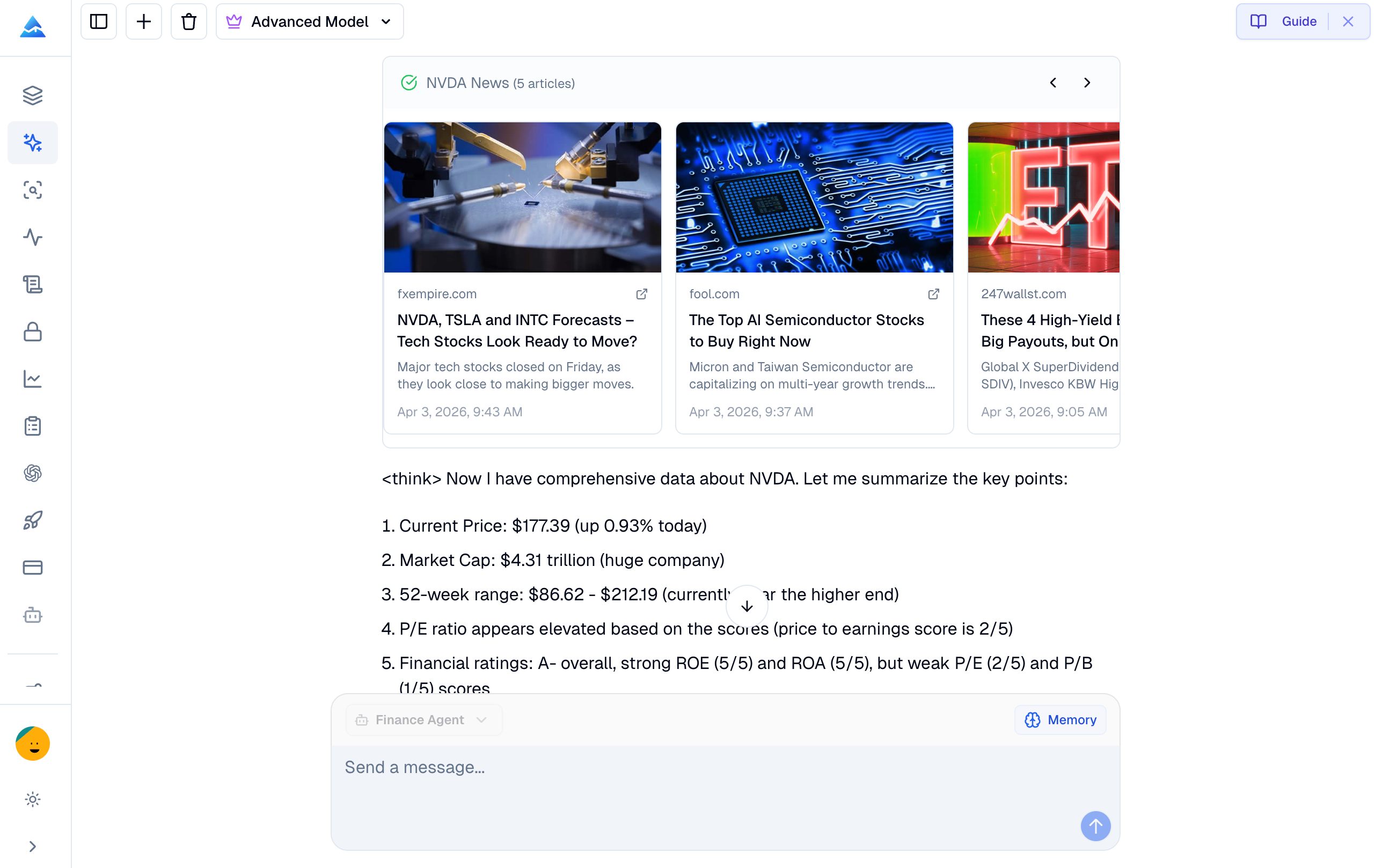
Instead of relying on a static training snapshot, Pineify's Finance Agent connects to over 95 professional financial data tools every time you ask a question. You get verified, current figures -- not a recollection of what was true six months ago.
I asked it for AAPL's current P/E ratio and financial breakdown last week. It returned the data with source timestamps. I asked ChatGPT the same question. It gave me textbook definitions but no actual numbers. That's the core difference.
The platform tracks over 11,000 stocks and more than 400 crypto and forex pairs around the clock. Whether you need a quick pre-market check or a detailed fundamentals report, it delivers institutional-grade data through a simple chat interface.
Features That Go Beyond ChatGPT
Here's what a finance-specific tool brings that a general chatbot can't.
Live Prices, News, and Market Sentiment
You get current stock prices, forex rates, and crypto values directly in the chat. It also pulls breaking financial news and gauges the real-time mood from X (Twitter) and Reddit. It summarizes what people are discussing in communities like r/wallstreetbets or r/investing and links to the source. This blend of hard data and social sentiment is something a general chatbot can't deliver.
Company Analysis Without the Manual Work
A general AI can explain what a P/E ratio is. This tool fetches the actual financials for the company you ask about -- income statements, balance sheets, cash flow -- and calculates the key ratios. The result is a clear summary that connects fundamentals, technicals, and analyst views.
A Stock Screener You Talk To
This is the feature I use most. You describe what you want in plain English: "Show me mid-cap healthcare stocks with low debt and positive earnings growth." The tool understands the request, screens against live data, and returns matching companies. No menus, no filters, no SQL.
Track Filings, Earnings, and Insider Activity
It monitors earnings calendars, SEC filings (10-K, 10-Q), insider trading, and institutional ownership changes. This "smart money" insight is usually locked behind expensive terminal subscriptions.
Options Analysis in Plain English
If you trade options, it displays option chains with Greeks (delta, gamma), implied volatility, and strategy breakdowns -- all through a conversation. I haven't tested every options tool on the market, but for a chat-based interface, this is the most functional one I've found. For a deeper look at derivatives-focused AI tools, check out the AI options trading platforms guide.
Pineify vs ChatGPT: A Direct Comparison
Here's how the two stack up on the features that actually matter for financial research:
| Feature | ChatGPT (with plugins) | Pineify AI Finance Agent |
|---|---|---|
| Live stock quotes | Limited / inconsistent | Yes, always real-time |
| Financial statements | No native access | Yes -- income, balance sheet, cash flow |
| Analyst estimates & targets | No | Yes |
| Options chains & Greeks | No | Yes |
| SEC filings (10-K, 10-Q) | No | Yes |
| Insider & Congress trades | No | Yes |
| Social sentiment (X, Reddit) | No | Live, AI-summarized |
| Natural language screener | No | Yes |
| AI buy/sell/hold recommendations | Hallucination-prone | Data-backed reasoning |
| Coverage | General knowledge | 11,000+ stocks, 400+ crypto/forex pairs |
I prefer having a tool that starts from facts, not training patterns. A general chatbot can discuss economic theory. The finance agent pulls a company's latest quarterly report and walks through the numbers.
Who Benefits Most
Pineify's Finance Agent works for anyone who needs accurate market information without the usual cost or complexity.
- Individual investors: Ask "Is AAPL overvalued right now?" or "Show me dividend stocks with a yield over 4%" and get plain-English answers backed by real data.
- Professional traders: Pull a company's financials, an options chain, or consensus analyst forecasts in seconds.
- Financial analysts: Get earnings call transcripts, revenue breakdown by segment, insider trades, and institutional ownership for deep research projects.
- Students: Use real-world data to learn. Ask "Walk me through a DCF valuation for MSFT" and see the theory applied with live numbers.
Real-World Workflows
Here are ways the tool fits into a regular research day.
Morning Market Check
Ask "What's moving in the market today?" and get a snapshot of pre-market movers, economic news, and sector strength. No hopping between five different sites.
Deep Company Dive
Ask "Analyze AAPL's financial health." The response connects revenue trends, profit margins, debt levels, and competitive positioning into a coherent picture.
Side-by-Side Stock Comparison
"Compare NVDA vs AMD on valuation and growth" gives you a structured view of P/E ratios, revenue growth, operating margins, and analyst consensus. This saved me about an hour of spreadsheet work last month.
Metric,Company A,Company B
P/E Ratio,45.2,28.7
Revenue Growth (YoY),22.5%,18.3%
Operating Margin,35%,24%
Analyst Consensus,Strong Buy,Buy
Options Strategy Ideas
For a stock or ETF like QQQ, ask "Suggest options strategies for QQQ." The suggestions are grounded in current implied volatility data.
Pricing
Most serious finance tools are expensive. Bloomberg terminals run about $24,000 a year. Premium data platforms cost hundreds to thousands annually.
Pineify uses a one-time payment model. The Expert Plan, which includes the full AI Finance Agent and the AI Stocks & Options Picker, costs $259 (normally $369). That includes monthly AI credits that refresh automatically, with no recurring fees.
| Service | Cost Model | Approximate Annual Cost |
|---|---|---|
| Typical Premium Data Platforms | Monthly Subscription | Hundreds to thousands per year |
| Bloomberg Terminal | Annual Subscription | ~$24,000 |
| Pineify Expert Plan | One-Time Lifetime Payment | $259 one time |
For less than what some platforms charge in a single month, you get access to similar institutional data.
Common Questions About AI Finance Agents
Q: Is Pineify's Finance Agent a licensed financial advisor? No. It's a research assistant that pulls and analyzes data. The final investment decisions are yours.
Q: How current is the market data? Stock prices, forex rates, and crypto quotes stream in real-time during market hours. Financial statements and SEC filings update the moment official sources release them.
Q: Can it analyze international markets? Yes. It covers exchanges in the US, Europe, and Asia, plus emerging markets, forex pairs, and major cryptocurrencies.
Q: Do I need a financial background to use it? No. You can ask questions in plain English. It works for beginners and experienced traders alike.
Q: What makes it different from ChatGPT? ChatGPT relies on a static training dataset. Pineify's agent pulls live, verifiable data from professional market data APIs. Every number it references is current and sourced, not guessed.
Try the Finance Agent Free
A general AI can help with emails and explanations. For money and investments, you need answers grounded in current data.
You can try Pineify's AI Finance Agent for free at https://pineify.app/finance-agent. Ask a question like "Is now a good time to look at NVIDIA?" and watch it pull together live data. Use the stock screener by describing your ideal investment in plain English.
If you also work with custom trading scripts, understanding how bar_index works in Pine Script is useful for accurate backtesting.
The goal is not to spend more hours on research. It's to use a tool that gives you better answers faster.