Why Is TradingView 10 Minutes Behind? Data Delays & Real-Time Fix

TradingView data delay is the 10-15 minute gap between live market prices and what shows on your chart. Free accounts get delayed data because exchanges charge for real-time feeds. Spot the yellow 'D' at the top of your chart? That's TradingView's direct signal — the asset you're watching is delayed.
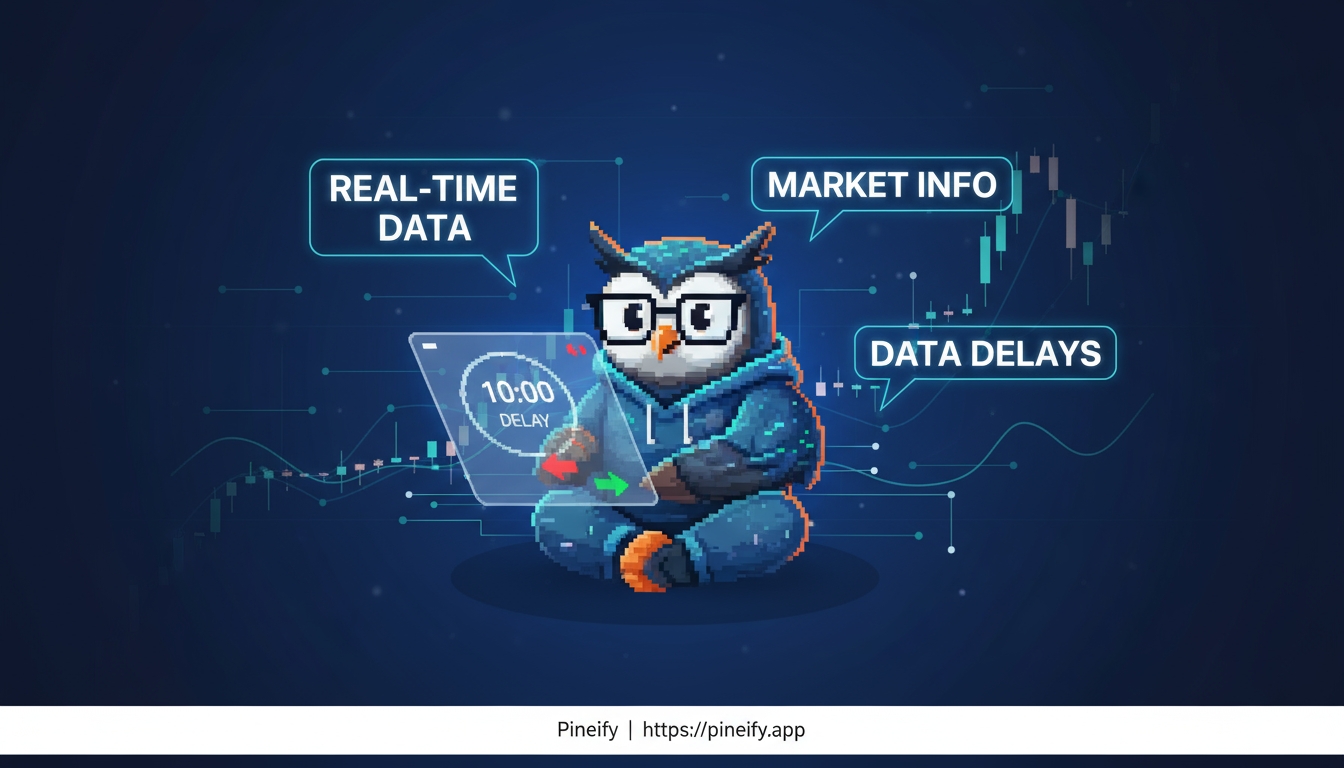
What Does "10 Minutes Behind" Actually Mean?
When your chart is 10 minutes behind, the price and timestamp you see are historical. You're looking at a snapshot from minutes ago. For active traders, that gap can mean missing a move entirely. I've watched SPY drop 0.8% in under two minutes while a friend on a free account saw nothing until the selloff was already over. That's what delayed data costs you.
Why Your TradingView Feed Lags
1. The Free Account Trade-Off
This one gets most people. Exchanges like Nasdaq and NYSE don't give away live data. TradingView's free tier is paid for by delayed data — you get the charts and tools, but prices arrive 10-15 minutes late.
- Not all assets lag the same way. Major futures like /ES sometimes stream close to real time. Stocks? Almost always delayed on a free account.
- Upgrade removes the delay for most markets. A paid plan is the cleanest fix if you trade stocks regularly.
2. Exchange Licensing — The Real Reason
TradingView isn't the source. Exchanges are. They license data under strict rules. Real-time feeds cost money, and that cost gets passed to users who need them.
If you've linked a broker account, check what data your broker gives you. I use Interactive Brokers, and linking it to TradingView got me live feeds for U.S. stocks without changing my TradingView plan. Some brokers restrict this on demo accounts though — I've tripped on that myself.
3. Your Plan Level Doesn't Cover Everything
Even on Pro or Premium, some markets require separate data packages.
- The yellow 'D' is your clue. See it? Click it. TradingView will tell you exactly which data subscription you're missing.
- Pro, Pro+, Premium — they're not equal. Higher tiers include more live data, but niche exchanges like the LSE or TSX often need an add-on.
| Subscription Tier | Typical Data Status | What You Need to Do |
|---|---|---|
| Free | Delayed (10-15 min) | Upgrade to a paid plan for live data on most assets. |
| Pro / Pro+ | Live data for many major markets. | May need add-on data packages for specific exchanges. |
| Premium | Most live data included. | Check for niche markets that still need separate packages. |
4. Your Location Can Play a Role
Some countries have data distribution restrictions. I haven't tested this personally with every region, but a friend in Brazil mentioned certain U.S. feeds stayed delayed even after upgrading. Worth checking if your market is fully supported where you are.
If you're building custom indicators for real-time use, a clean chart layout helps — check out how to use Pine Script transparent color to keep your workspace readable.
How to Fix the Delay — Step by Step
Step 1: Read the Yellow 'D'
First thing I check every time. If you see that icon, click it. TradingView pops up exactly what data package you need and how much it costs. No guessing.
Step 2: Upgrade Your Plan
If you're on a free plan, paid tiers (Pro starts around $12.95/month) give you live data for most U.S. stocks and forex. You'll still need add-ons for some exchanges.
Step 3: Buy Real-Time Data Packages
In your account settings, there's a "Real-Time Data" section. Browse by exchange. Nasdaq and NYSE packages are the most common buys. I pay $4/month for CBOE data, and it covers my options trading.
Step 4: Connect Your Broker
Link a funded brokerage account. Interactive Brokers, TradeStation, TD Ameritrade — all work. TradingView pulls the broker's real-time feed once the connection is active. I've done this and it works immediately.
One caveat: demo accounts won't help. I connected a practice IBKR account once and still got delayed data. Only live, funded accounts pass the real-time feed through.
Step 5: Double-Check Time Zone Settings
This sounds too simple, but I've accidentally set a chart to "America/New_York" while trading ASX stocks. The time offset made the data look hours stale when it wasn't. Check your chart settings — it takes five seconds.
Step 6: When Nothing Works
If you've done all the above and charts still lag:
- Log into your broker and verify your data-sharing settings.
- Contact TradingView support directly. They can audit your account's data subscriptions.
- Search the TradingView community forums — someone's almost certainly had your exact issue.
Why Real-Time Data Matters More Than You'd Think
Trading on delayed data is like driving with fogged windows. You can see shapes, but not the details. Here's what goes wrong:
- Bad entries. I entered a QQQ trade based on data that was 8 minutes old. The price had already moved $0.40 against my intended entry. The difference? About $80 on a small position.
- Wasted setups. A head-and-shoulders pattern forms and breaks in under 3 minutes. On delayed data, you see the breakout after it's done.
- Indicators lie to you. RSI, MACD, moving averages — they all compute from price. Stale price in = bad signals out.
If you're writing custom Pine Script indicators, every calculation depends on the price it receives — Volume Weighted Average Price (VWAP) in Pine Script is a good example of an indicator that becomes useless with stale data.
Real-time data isn't a luxury. It's the difference between informed trades and expensive guesses.
Free vs Paid — What You Actually Get
| Feature | Free Account | Paid Account (with Add-Ons) |
|---|---|---|
| Price Data Updates | 10-15 Minute Delay | Real-Time* |
| Bid/Ask Quotes | Delayed | Instant (if broker linked) |
| Market Coverage | Most Exchanges Delayed | Most Exchanges Real-Time |
| Analytical Features | Basic | Advanced |
*Some markets require an extra data subscription even on paid plans.
For casual investors checking positions twice a day, the free account works fine. That hour-long delay on AAPL or MSFT doesn't matter if you're holding for months.
For active traders — anyone who opens a position more than a few times a week — the paid plan is table stakes. For traders who use automated signals, feeding live data into a Pine Script trading bot is the only way to get accurate execution. The speed difference changes how you execute. I wouldn't trade options without real-time data, full stop.
Keep Your Charts Live
A few habits I've picked up:
- Check the bell icon. TradingView posts known data issues there.
- Review your subscriptions monthly. Data packages expire. I lost my CBOE feed once without noticing for three days.
- Seasonal deals are real. Black Friday and New Year promotions drop Premium pricing significantly. I grabbed an annual Premium plan at 40% off last year.
- Ask when you're stuck. TradingView support and the community forums have solved every issue I've hit.
Frequently Asked Questions
Q1: Why does my TradingView show a 10-minute lag on the charts?
A: Free accounts and some assets require a specific data subscription. Upgrade your plan, then buy the real-time feed for the exchanges you trade.
Q2: Is every asset delayed in TradingView?
A: No. Major futures contracts like /ES and some forex pairs stream in real time even on free accounts. Stocks, indices, and most global exchanges need a paid subscription.
Q3: Will connecting my broker account solve the lag?
A: Usually yes, if you link a funded account. Demo and practice accounts still deliver delayed data in most cases.
Q4: Why does the data delay vary by asset or region?
A: Each exchange sets its own data licensing rules. Some allow delayed data for free; others require a paid license for any real-time access.
Q5: How do I know if I'm trading on real-time data?
A: Look for the yellow "D" at the top of your chart. No symbol usually means live data. Your account settings also list active subscriptions.