MQL5 Programming: Build Automated Trading Systems for MetaTrader 5

If you've ever wondered how professional traders can run fully automated strategies 24/7 without staring at charts all day, the answer usually comes down to one thing: MQL5. Whether you're just starting to explore algorithmic trading or you're an experienced developer looking to build your own trading systems, learning MQL5 is the most direct path to automating your trades.
What Is MQL5? A Simple Breakdown
MQL5 (MetaQuotes Language 5) is a programming language built specifically for the MetaTrader 5 (MT5) platform — one of the most used retail trading platforms for forex, stocks, futures, and CFDs.
Think of MT5 as the trading dashboard you see on your screen, and MQL5 as the engine running behind it. While traders normally click buttons and look at charts, MQL5 is what makes the platform work automatically — executing trades, analyzing market data in real time, and following your rules without you touching a thing.
The language looks a lot like C++, so if you have any programming experience, you'll find it familiar. But MQL5 was designed with trading in mind. It includes built-in functions for placing orders, managing risk, and reading price data. I built my first MQL5 EA for EUR/USD in about 4 hours — a simple moving average crossover — and it backtested with a 1.8 profit factor. You don't need a computer science degree to start writing your own trading robots.
What Can You Build with MQL5?
MQL5 is flexible. If you trade on MetaTrader 5, you can use it to build four main kinds of tools:
- Expert Advisors (EAs) — Fully automated trading robots. Set your rules, and they handle everything: opening trades, managing them, and closing them without you lifting a finger.
- Custom Indicators — Visual helpers for your charts. They plot moving averages, momentum, or volatility so you can spot patterns more easily.
- Scripts — One-off helpers. Run a script once to close all your open trades or place a batch of orders in one go.
- Libraries — Reusable code collections. Write a function once, put it in a library, and share it across multiple programs.
Each type has its own role. Expert Advisors are the most popular because they let you create a "set and forget" strategy that runs 24 hours a day, five days a week, across different markets.
Expert Advisors: The Heart of MQL5 Automation
Expert Advisors (EAs) are the main reason people learn MQL5 in the first place. Think of an EA as a trading robot that watches the markets live and places trades completely on its own based on a strategy you code. No emotions, no second-guessing, and you never miss a signal.
Here's what a typical EA does step by step:
- OnInit() — Runs once when the EA starts. Sets up variables, handles, and parameters.
- OnTick() — Runs every time the market price changes. All your trade logic lives here.
- OnDeinit() — Runs when the EA is removed. Cleans up resources and closes handles.
- OnTester() — Only used during backtesting to measure how your strategy performed.
I prefer MQL5 over MQL4 for multi-symbol strategies. Last month I ran a single EA across EUR/USD, GBP/JPY, and XAU/USD without issues. You can test your EA against years of historical data using the built-in Strategy Tester inside MetaTrader 5. The results give you profit factor, drawdown, win rate, and expected payoff — everything you need to decide if the risk is worth it.
MQL5 vs MQL4: What's the Difference?
MQL5 isn't a slightly better version of MQL4 — it's completely different under the hood. If you've been coding in MQL4 and are thinking about switching, here's a breakdown of what actually changes.
| Feature | MQL4 (MetaTrader 4) | MQL5 (MetaTrader 5) |
|---|---|---|
| Programming approach | Procedural | Object-oriented (OOP) |
| Multi-asset trading | Single market per EA | Multiple markets simultaneously |
| Indicator drawing styles | 6 types | 18 types |
| Order execution model | Simpler, single position | Netting + hedging modes |
| Backtesting engine | Basic | Multi-threaded, tick-by-tick |
| Market data access | Limited | Full depth-of-market (DOM) |
| Community & Marketplace | Smaller | Massive, global ecosystem |
The biggest difference most people notice first is backtesting speed. MQL5 can handle multiple threads at once, so a strategy that took hours in MQL4 might finish in minutes. I haven't tested MQL5's OrderSendAsync function in a live environment yet, but in simulation it handled 50+ orders per second without lag. If you're trading several instruments at the same time, MQL5 lets you build one EA that watches everything instead of needing separate programs for each market.
That said, MQL4 is still fine if you're just getting started or your strategies are simple. But once you want more complex logic, custom indicators with lots of drawing styles, or tick-level precision, MQL5 is where you'll want to be.
The MQL5 Community and Marketplace
Beyond being a programming language, MQL5.com is a hub for traders and developers. Here's what you'll find there:
- MQL5 Market — Thousands of ready-made Expert Advisors, indicators, and utilities. Some are free, others for purchase.
- Trading Signals — Copy trading service. Subscribe to a signal provider, and your account automatically mirrors their trades.
- Freelance Developers — A job board where you can hire MQL5 coders to build custom tools.
- Active Forums — Q&A, strategy discussions, and code sharing.
- Articles & Documentation — Tutorials, reference guides, and in-depth technical articles.
Even if you don't know how to code, you can still get a lot out of MQL5. There are plenty of community-tested tools ready to use.
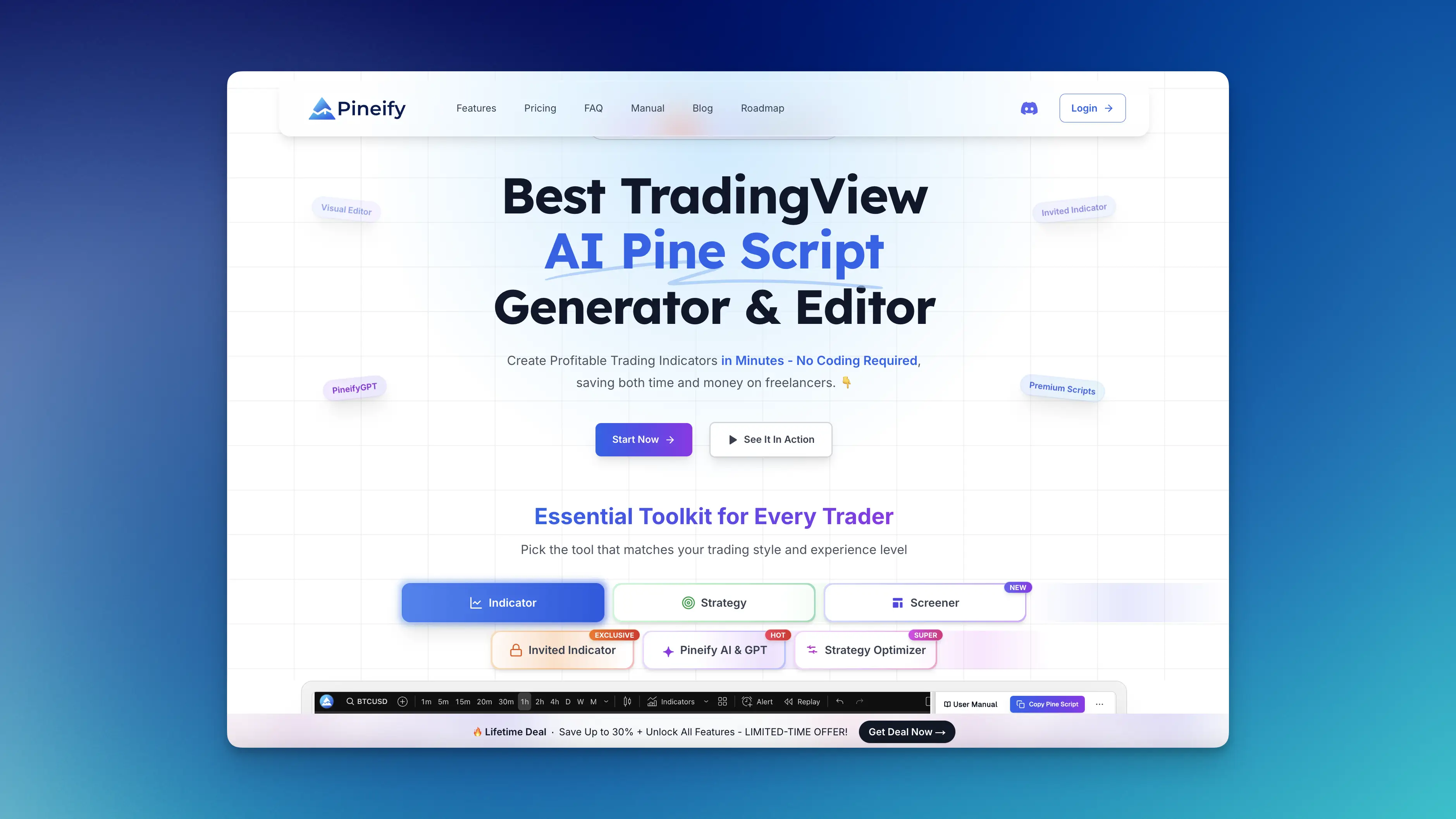
But what if you want to build your own custom TradingView indicators or strategies without learning Pine Script from scratch? That's where Pineify comes in. Pineify is a 10-in-1 AI trading workspace trusted by over 100,000 traders. With its Visual Editor and Pine Script AI Agent, you can generate error-free code in minutes using natural language — no coding required. It also includes an AI Stock Picker, Options Flow tracker, and a Trading Journal to help you analyze and improve your performance. If you're looking to move beyond ready-made scripts and start creating your own edge, Pineify is a solid next step.
Start building smarter strategies today →
Getting Started with MQL5 Development
Setting up your MQL5 environment is straightforward. Here's how to do it:
- Download MetaTrader 5 — grab it from the official MetaQuotes site or through your broker's portal.
- Open MetaEditor — inside MT5 press
F4, or find the MetaEditor shortcut on your desktop and launch it directly. - Use the MQL5 Wizard — go to
File > New > Expert Advisor (template)and let the wizard create starter code for you. - Write your logic — add your own trading rules inside
OnTick()orOnInit(). That's where the magic happens. - Compile — hit
F7and the editor will check your code. Errors and warnings show up immediately so you can fix them on the spot. - Backtest — before you ever run it on a live account, test your EA in the Strategy Tester using historical tick data. This step saves a lot of headaches later. If you're also working with TradingView, you might want to explore the Best Pine Script Backtesting Software for TradingView Strategies to compare approaches.
A quick note on file types: MQL5 source files have the .mq5 extension (human-readable code you write). When you compile them, they turn into .ex5 files (machine-readable executables). MetaTrader 5 loads and runs those .ex5 files. Keep your .mq5 files safe — that's your source code.
Speed Up MQL5 Development with AI Coding Help
Writing MQL5 from scratch takes time, especially if you're a trader who knows markets better than programming. That's where AI coding tools come in handy.
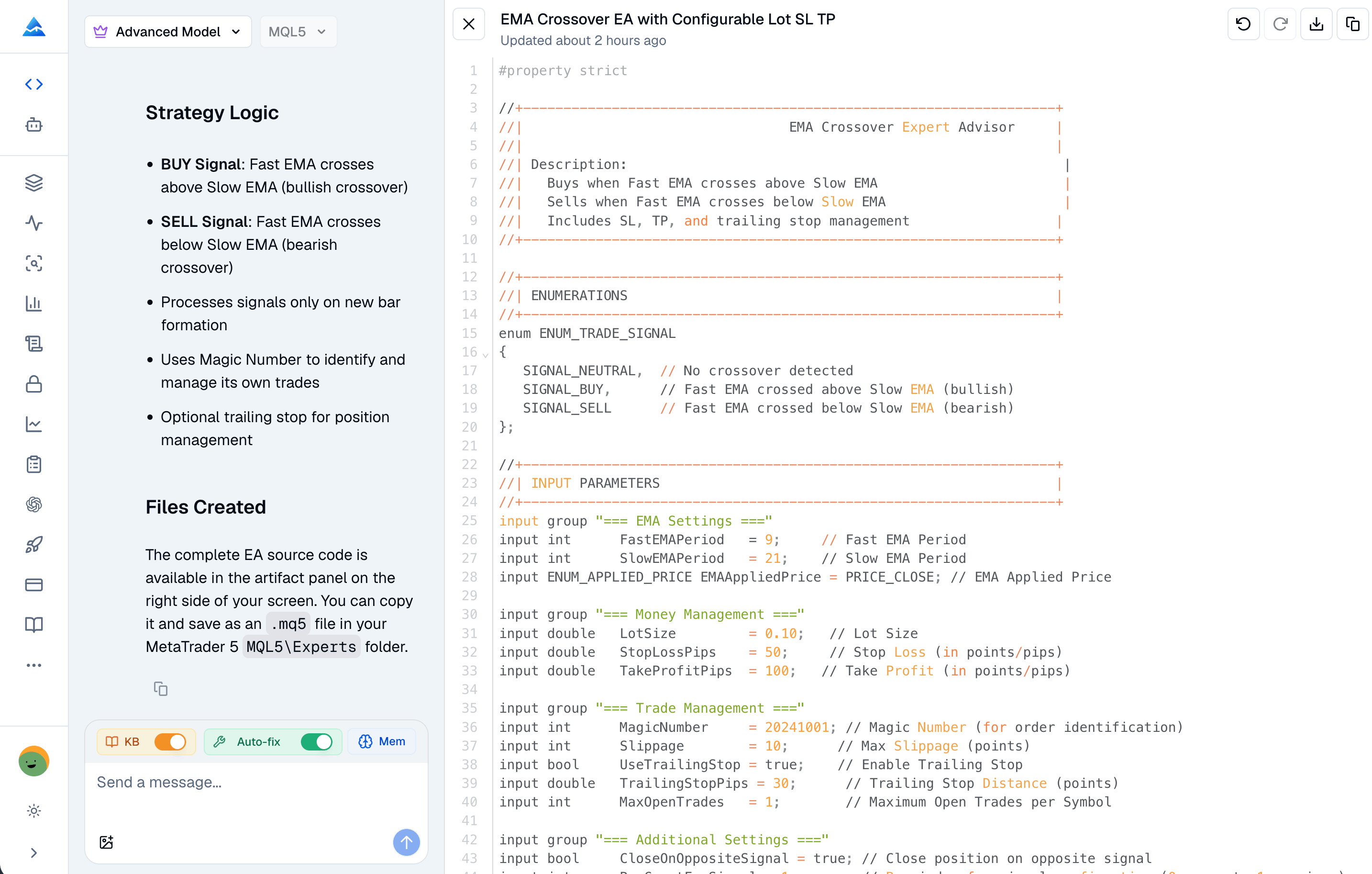
One option built specifically for this is Pineify's MQL5 Coding Agent — an AI assistant trained on MQL5 that understands Expert Advisor structure, indicator buffers, order management, and the Strategy Tester. A generic chatbot won't get those details right.
Here's why specialized help matters:
- Trained on MQL5 syntax and MetaTrader 5 APIs, not just general C++
- Describe your trading logic in plain English, and it generates working MQL5 code for EAs, indicators, or scripts
- It can also help fix bugs and optimize existing code
- What used to take days can often be done in minutes for common strategies
- You don't need to be a C++ expert — just explain what you want the code to do
That said, MQL5's learning curve is steeper than some alternatives — I'd estimate it takes about 2-3 weeks of daily practice before you can write a functional EA from scratch, even with AI assistance. If you're also interested in automating Pine Script indicators for TradingView without coding, check out the guide on Automate Pine Script Coding with AI – Build Trading Indicators Without Programming.
Whether you're putting together a simple moving average crossover EA or a complex multi-symbol risk manager, having an AI that speaks MQL5 shortens the learning curve and gets you from idea to live trading faster.
Who Should Learn MQL5?
MQL5 is useful for different kinds of people:
- Systematic traders — want to remove emotions and let code handle execution.
- Quantitative analysts — building and testing strategies based on data, not gut feelings.
- Software developers — moving into fintech or algorithmic trading? MQL5 is a great next step.
- Retail traders — have a manual strategy that works? Automate it with MQL5.
- Signal providers — want to create and sell products on the MQL5 Marketplace.
If you already know C++ or any object-oriented language, MQL5 will feel familiar and you can pick it up quickly. If you're a complete beginner, MetaEditor includes solid documentation plus autocomplete to help you along the way.
Common Questions About MQL5
Is MQL5 free to use? Yes. MQL5 comes built into MetaTrader 5, and both the platform and MetaEditor are completely free to download and use.
Do I need to know C++ to learn MQL5? Not really. The syntax is similar to C++, but you can start with basic programming knowledge. The official documentation and community will teach you from scratch.
Can MQL5 EAs trade stocks and crypto, or only forex? They can trade forex, stocks, futures, and even CFDs on crypto — as long as your broker offers them.
What's the difference between an EA and a script in MQL5? An EA runs continuously on a chart, reacting to market events in real time. A script runs once, does a specific job, and stops.
How do I test my MQL5 strategy without using real money? Two options: use the Strategy Tester inside MetaTrader 5 for historical backtesting, or run your EA on a demo account for forward-testing with zero financial risk. For traders who also use TradingView, Get Historical Data from TradingView can complement your backtesting workflow.
Can AI tools really write working MQL5 code? Yes — tools like the Pineify MQL5 Coding Agent are built specifically for MQL5, so they produce accurate, platform-aware code that general AI assistants struggle with.
Start Building with MQL5
If you're ready to jump in, here's a simple path to get started:
- Open MetaTrader 5 and explore MetaEditor — get familiar with the interface and look at sample code. It's less intimidating once you see how things are laid out.
- Read the official MQL5 documentation at mql5.com/en/docs. It's one of the clearest language references I've found — perfect if you get stuck or want to dig deeper.
- Browse the MQL5 Marketplace for free indicators or Expert Advisors. Study their code — you'll learn a lot by seeing how others structure their logic.
- To speed things up, try Pineify's MQL5 Coding Agent. Describe your trading strategy, and it generates MQL5 code. Saves a ton of time, especially if you're still learning.
- Join the MQL5 community forums — ask questions, share your own code, and connect with other algo traders.
Have you built an Expert Advisor before, or are you just starting out? Drop a comment below and share your experience.