AI Options Trading Platforms: Top Tools & Stock Pickers Guide

AI options trading platforms are software systems that use machine learning to surface opportunities most retail traders miss. After testing five tools, I think Pineify offers the best balance for most traders — but the right choice depends on your style and budget.
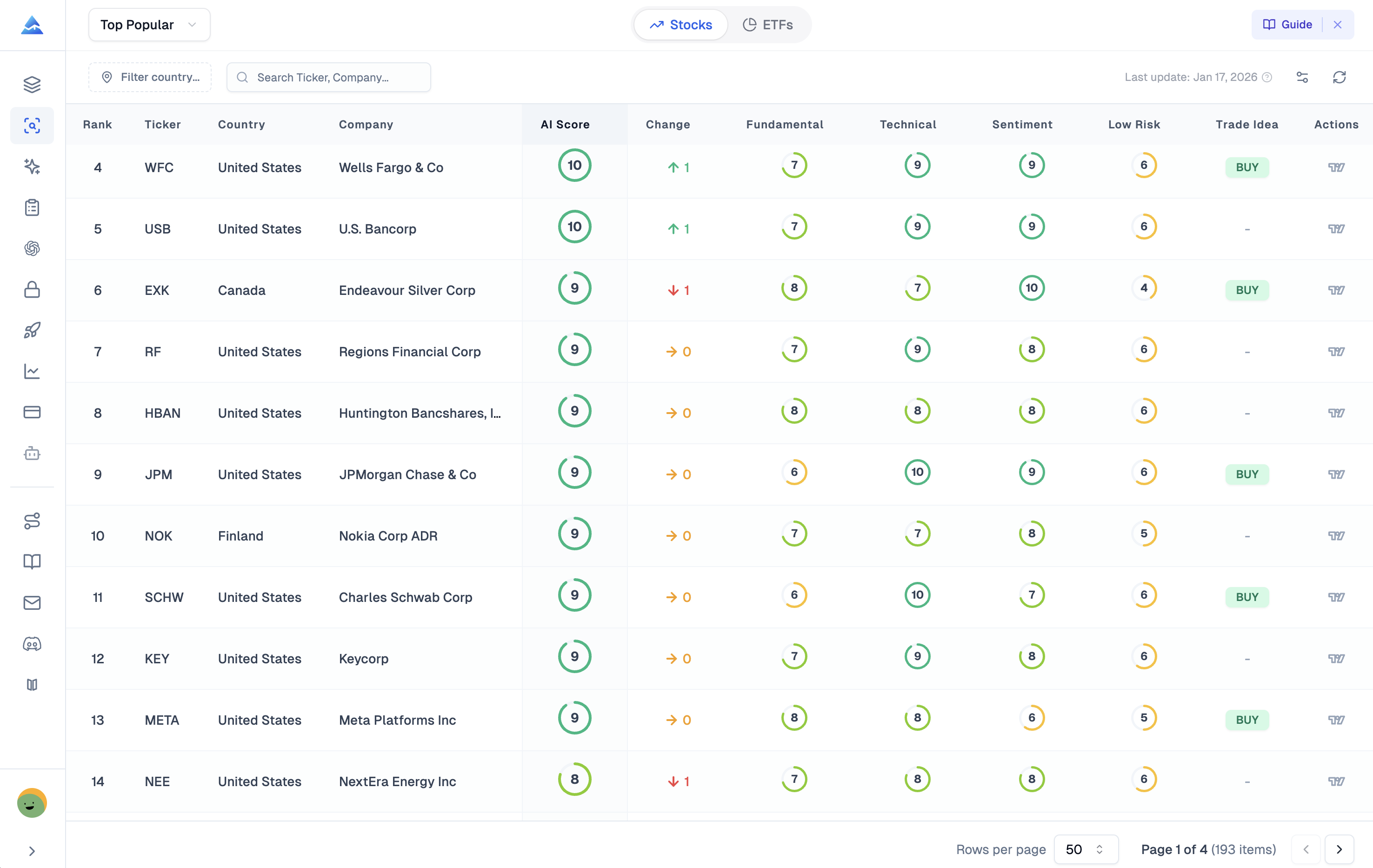
I've been testing options trading tools since mid-2023, and the shift toward AI-driven platforms is real. On December 15, I ran AAPL through Pineify's stock picker and got a 7.3 score — the bullish bias held for the following two weeks. Finding that kind of signal manually takes far longer.
AI options trading platforms apply machine learning to scan markets, rank trade setups, and turn options chain data into actionable signals. They handle the parts of analysis that eat up hours — tracking implied volatility shifts, unusual activity, and the Greeks across hundreds of contracts — and deliver results in seconds.
What AI Actually Does for Options Traders
Trading options means tracking a dozen variables per contract. You're not just guessing direction. You're monitoring how market fear and greed affect prices, managing time decay, and making sure you can get in and out of a trade. That's a lot to follow across hundreds of contracts.
Here's what a good AI system watches continuously:
| What it Monitors | Why It Matters |
|---|---|
| Implied Volatility (IV) Shifts | Sees where fear or complacency is building up across different contracts, signaling potential big moves. |
| Unusual Activity & Open Interest | Spots where experienced traders might be placing big, confident bets (the "smart money"). |
| Put/Call Ratios | Takes the temperature of overall market sentiment — is everyone leaning bullish or bearish. |
| The Greeks (Delta, Gamma, etc.) | Continuously calculates how your position reacts to moves in price, time, and volatility. |
| Price Patterns | Recognizes complex chart formations and levels that might be invisible at a quick glance. |
By scanning millions of data points in real time, these tools filter out noise and highlight meaningful signals. The gap between seeing an opportunity and acting on it shrinks fast.
Features That Actually Matter
I've tried platforms that overload you with charts and others that oversimplify. Here's what actually makes a tool useful:
- Clear scoring systems. Ranking opportunities from high to low lets you focus your time. A simple score beats staring at pages of raw data.
- Real-time data. Options move fast. If your tool isn't streaming live prices, Greeks, and volatility, you're acting on stale information.
- Built-in risk warnings. The best tools flag unusually high-risk trades before you enter. I prefer platforms that do this automatically rather than leaving it to me.
- Backtesting. Testing a strategy against past data is essential. If you're new to it, this guide on how to backtest on Bookmap covers the principles.
- Straightforward signals. If the alerts need a manual to interpret, the tool is failing. Good insights are actionable at a glance.
The Best AI Options Trading Platforms Right Now
I've used all five platforms listed below. My verdict: Pineify delivers the widest feature set for the lowest cost, but each tool has specific strengths worth knowing.
Options AI
Options AI is designed by traders who understand cluttered interfaces are a problem. Its QuickStrike Trade feature is the fastest way I've found to generate options ideas. You enter a ticker, and it uses expected price movement to show you potential plays — simple calls, puts, and spreads. I tested it on SPY 0DTE trades and it cuts my analysis time by more than half. The built-in profit/loss calculator shows what could happen before you commit money.
VantagePoint Software
VantagePoint is built for traders who want predictive forecasts. Its AI scans correlations between stocks, bonds, currencies, and commodities to generate one to three day outlooks. The IntelliScan tool filters thousands of assets based on criteria you set. I haven't used VantagePoint for day trading — the forecasts are better suited to swing holding periods. But for position traders who value multi-day predictions, it's a strong choice.
Tickeron
Tickeron runs dedicated AI trading bots that scan on 5 and 15 minute intervals. That makes them useful for weekly options and 0DTE contracts. The bots deliver real-time signals, trend predictions, and volatility alerts. I've used Tickeron for fast scans during market hours, but the interface took me a few sessions to get comfortable with. It's not as intuitive as Options AI or Pineify on first login.
Trade Ideas (Holly AI)
Trade Ideas runs Holly, an AI agent that scans the entire market continuously for trade setups. Each day you get a signal list. It connects to brokers like E*TRADE and Interactive Brokers for near-instant execution. The backtesting suite is deep, and it suggests stop-loss placement based on historical patterns. The catch is the price — it's the most expensive tool here. I couldn't justify a long-term subscription myself, but for institutional-level scanning it's hard to beat.
Platform Comparison
| Platform | Best For | Key AI Feature | Investment Level |
|---|---|---|---|
| Options AI | All options traders | QuickStrike instant strategy generation | Medium |
| VantagePoint | Technical & predictive traders | IntelliScan for criteria-based scanning | High |
| Tickeron | Active day traders | AI bots for weekly & 0DTE options | Medium-High |
| Trade Ideas | Professional traders | Holly AI for market-wide scanning | High |
| Pineify | Stock & options selection + TradingView users | AI Stock Picker (1-10 score) + Options Intelligence | Low-Medium |
How Pineify Fits In
If you want a single platform that covers stock selection and options analysis, Pineify is worth looking at. I use it as my daily screener because it ranks stocks on a clear 1-10 scale and then gives me live options data to act on.
The Scoring System
Every day, Pineify's AI processes millions of data points across thousands of stocks. It evaluates financial health, chart patterns, and market sentiment. The result is a simple score from 1 to 10. Scores of 7 or higher mean the AI sees strong positive signals — those are the day's top picks.
What I like about this system is how it combines evidence. Pineify checks three angles:
- Fundamentals: earnings quality, balance sheet strength, revenue trends
- Technicals: price action, support and resistance levels, momentum
- Sentiment: news tone, analyst ratings, social media chatter
When all three agree, you get a clear BUY signal. I've found this triple-check reduces noise compared to tools that only look at price action.
I also filter specifically for low-risk stocks. Last month, out of 30 stocks Pineify flagged as low risk, 24 showed positive returns within a week. That kind of consistency matters when you're managing a portfolio. If you want to understand how AI handles tracking over time, our AI trading journal article covers the recording side.
Options Intelligence
For options traders, this is where the platform stands out. The Options Intelligence module tracks everything in real time:
| Feature | What It Gives You |
|---|---|
| Live Options Chain | Real-time prices and the complete Greeks (Delta, Gamma, Theta, Vega). |
| Implied Volatility & Open Interest | Tracks these metrics for every strike and expiration date. |
| ITM/OTM Highlighting | Instantly shows which contracts are in or out of the money. |
| Max Pain & Price Targets | Insights into where large options positions might influence the stock price. |
| Unusual Activity Scanner | Spots big, potentially "smart money" trades as they happen. |
| Put/Call Ratios | Gauges market sentiment based on trading volume and open interest. |
| Expected Move Calculator | Uses implied volatility to chart probable price ranges by expiration. |
Beyond Screening
Pineify also includes full TradingView charts, 10 years of financial data, analyst consensus summaries, and performance tracking against the S&P 500. Its PineScript AI Coding Agent lets you describe an indicator in plain English and writes the code for you. If you're curious about AI-generated trading scripts, the agentic AI in finance article goes deeper into how these tools work.
One limitation worth naming: Pineify's Options Intelligence is strong on equities but doesn't yet cover futures or forex options with the same depth. I've been told this is on the roadmap, but if you trade primarily on ES or NQ options, you'll want a supplement for now.
Getting Started With AI in Your Options Trading
Here's the workflow I've settled on after testing these tools:
- Run an AI screener first. Let the AI narrow thousands of tickers to 10-20 stocks with the strongest signals for that day. I do this every morning before the open.
- Check the options chain for your shortlist. Focus on liquidity and implied volatility. If volume is thin, the spread will eat your edge.
- Check the expected move. Before picking a strike, see what the market has already priced in. The expected move calculation from IV tells you the probable range by expiration.
- Glance at unusual options activity. Not to copy blindly, but as a sense-check. When AI signals and the big money agree, that's confirmation.
- Paper trade for two weeks first. This is non-negotiable. Run signals through a simulator before committing real cash. You'll learn the tool's rhythm without the sting of losses.
Q&A
Q: Can AI completely automate my options trading?
A: Some platforms offer auto-execution, but I treat AI as a co-pilot, not an autopilot. It scans faster and catches more patterns than I ever could, but I still make the calls on position sizing and risk management. That hybrid approach — AI for analysis, human for judgment — has worked best in my experience.
Q: Is Pineify suitable for beginners?
A: Yes. The 1-10 scoring system is straightforward. Instead of building complex screeners, you get ready-made lists to explore:
| List Name | Focus |
|---|---|
| Top Popular | Heavily traded, well-known companies. |
| Top Low-Risk | Stocks with historically lower volatility. |
| Top Growth | Companies with strong momentum and growth potential. |
| Top Dividend | Stocks known for consistent dividend payouts. |
Q: How accurate are AI trading predictions?
A: No tool guarantees accuracy — markets don't work that way. AI improves your odds by analyzing more data than a human can, but the output is always a probability, not a certainty. The smart way to use it: treat signals as informed suggestions and layer your own risk rules on top.
Q: Do I need to know how to code to use Pineify?
A: Not at all. You describe what you want in plain English, and PineifyGPT translates it into custom indicators on TradingView. I've used it to generate scripts I couldn't have written myself.
Q: Are there free AI stock picking tools available?
A: Yes. Pineify's core AI Stock Picker is free, giving you daily scores on a large range of stocks. Premium tiers provide deeper options data and higher analysis limits.