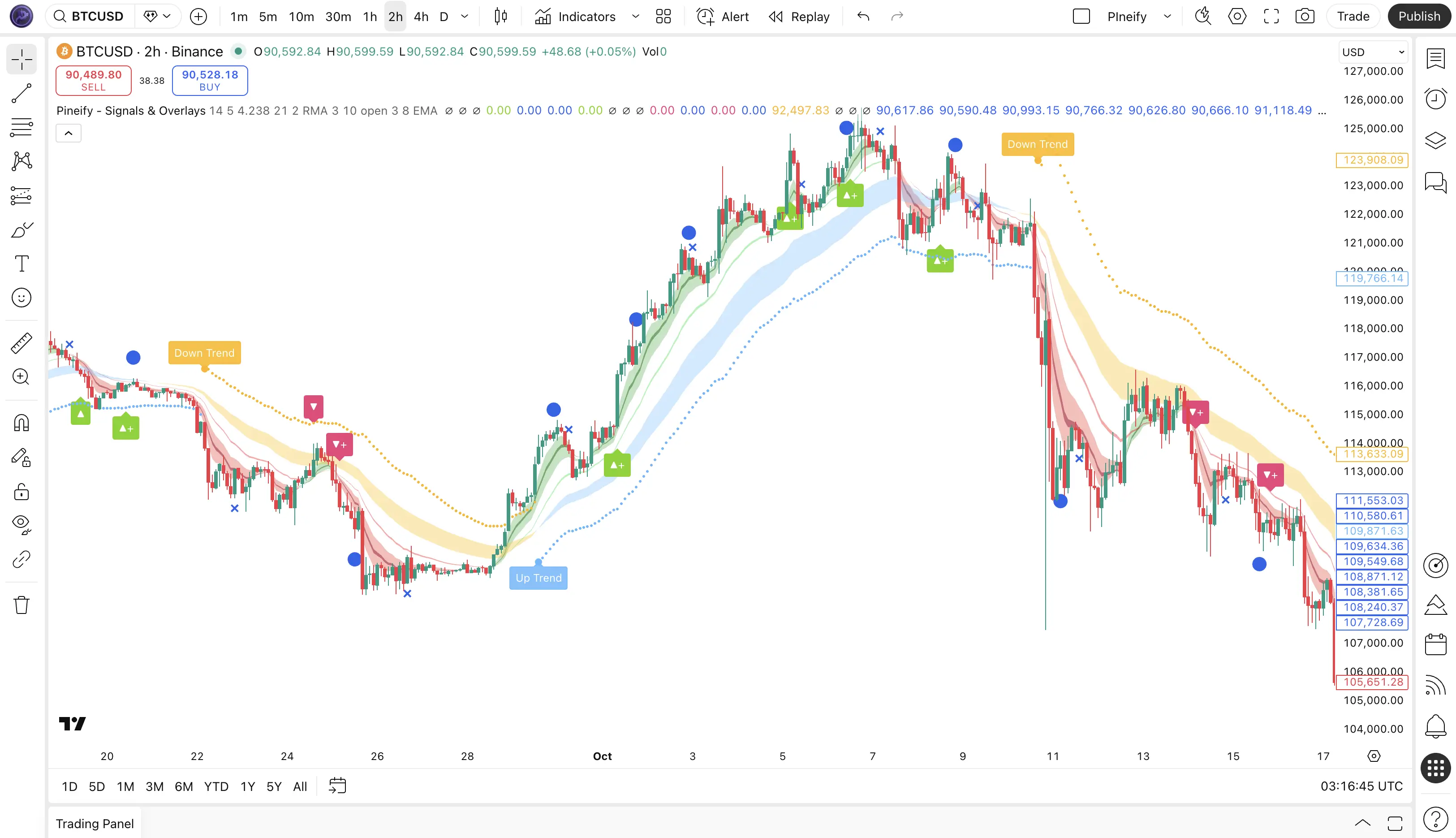
Pineify's invite-only indicator is a TradingView script with an access-request workflow in the Pineify app. Access permission, chart signals, and a tested trading strategy are three different things. Before purchasing access, check the current entitlement and TradingView's announced change to commercial script distribution.
Bull Bear Power (BBP) compares the high and low of a bar with a moving average. TradingView's built-in version adds the two distances into one value. A positive reading describes that calculation; it does not identify institutional buying or establish that a profitable trade is available.
Pineify's Candlestick Patterns indicator exposes 16 Boolean pattern outputs. Each output answers whether its implemented OHLC conditions are satisfied. A label is not proof that a reversal will follow, and the script does not automatically scan every open chart or instrument.
The Chande Momentum Oscillator (CMO) measures the balance of upward and downward price changes over a window. A positive reading means upward changes outweigh downward changes in that calculation. It does not establish that buyers will continue to dominate or that a reversal is more likely at a particular threshold.
The Chop Zone indicator in Pineify colors columns according to a normalized moving-average angle. Its EMA length is fixed at 34. The editable Periods input defaults to 30 and controls the high/low range used for normalization; it does not change the EMA to a 30-period average.
That distinction matters when comparing settings. Changing Periods alters the scale of the angle, so a different color does not necessarily mean the underlying EMA slope changed.
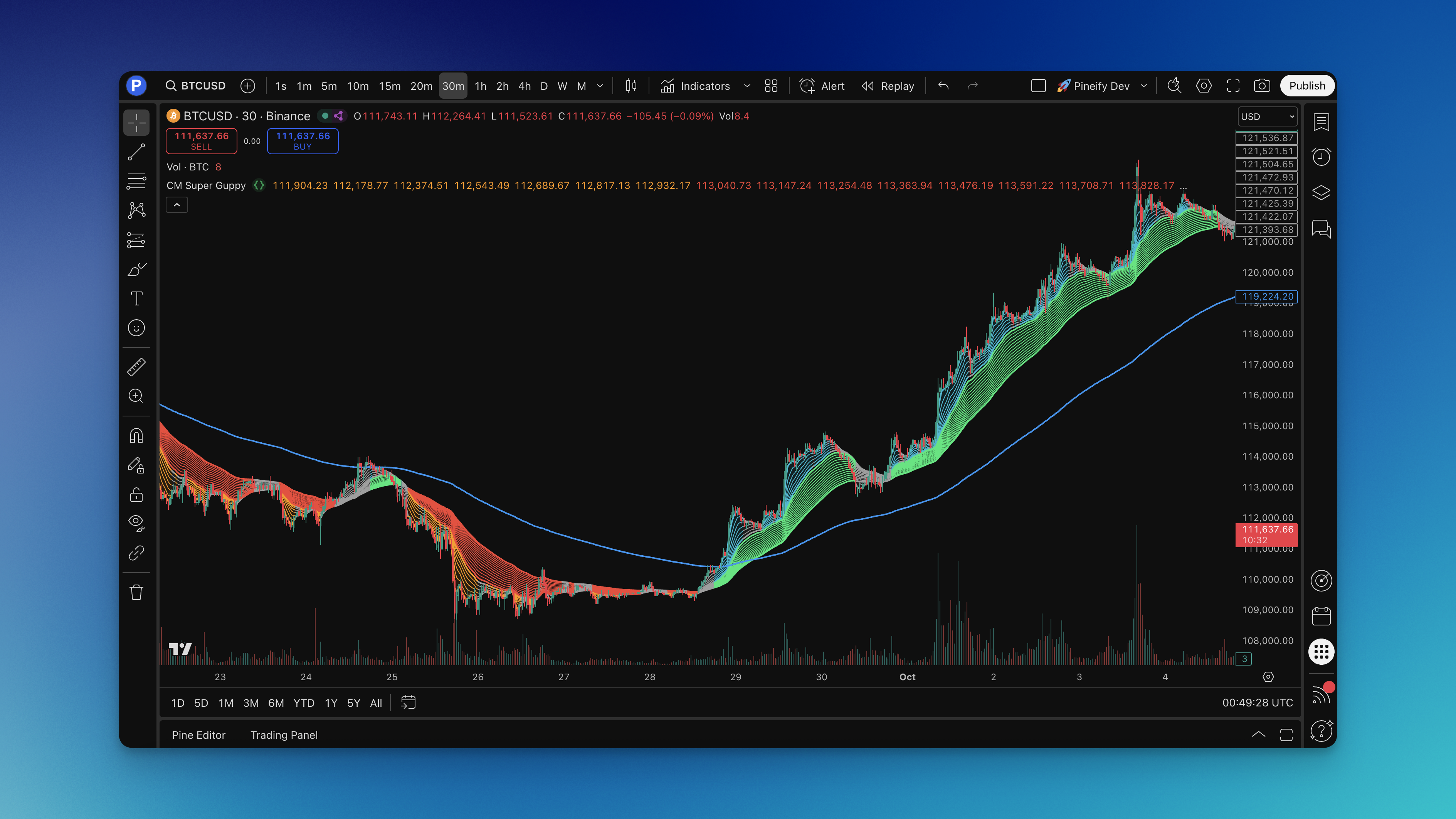
CM Super Guppy displays two groups of exponential moving averages and a longer reference average. Its colors summarize how those averages are ordered. The ribbon can help describe a trend, but its 23 lines are related calculations from price, not 23 independent confirmations of a trade.
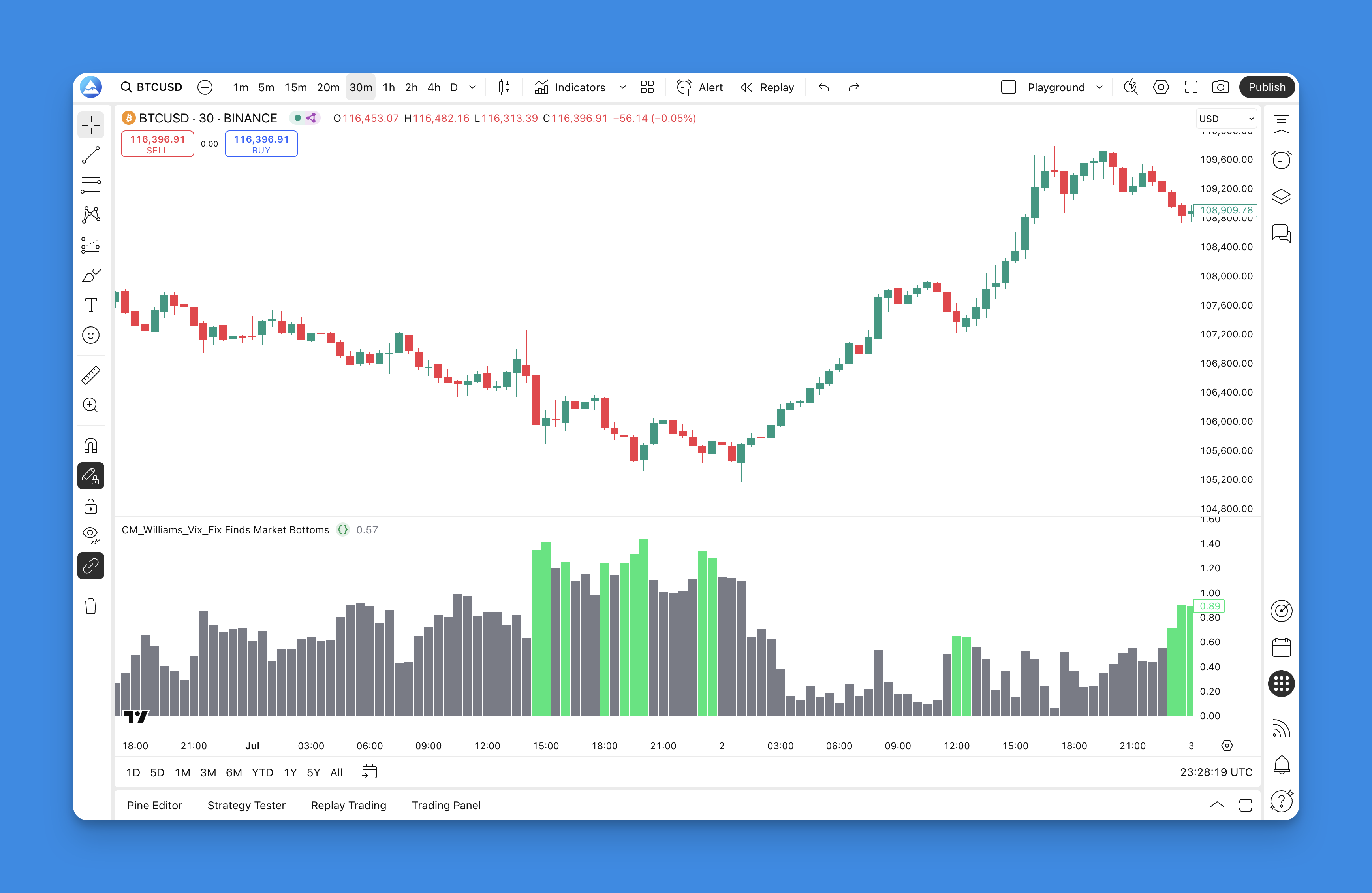
The Williams VIX Fix measures the distance between the current low and the highest recent close, as a percentage of that highest close. Chris Moody's CM_Williams_Vix_Fix publication attributes the idea to Larry Williams and adds threshold-based highlighting.
A large reading identifies a large downward price excursion relative to the selected reference. It does not establish that selling is exhausted or that the next trade will be profitable.
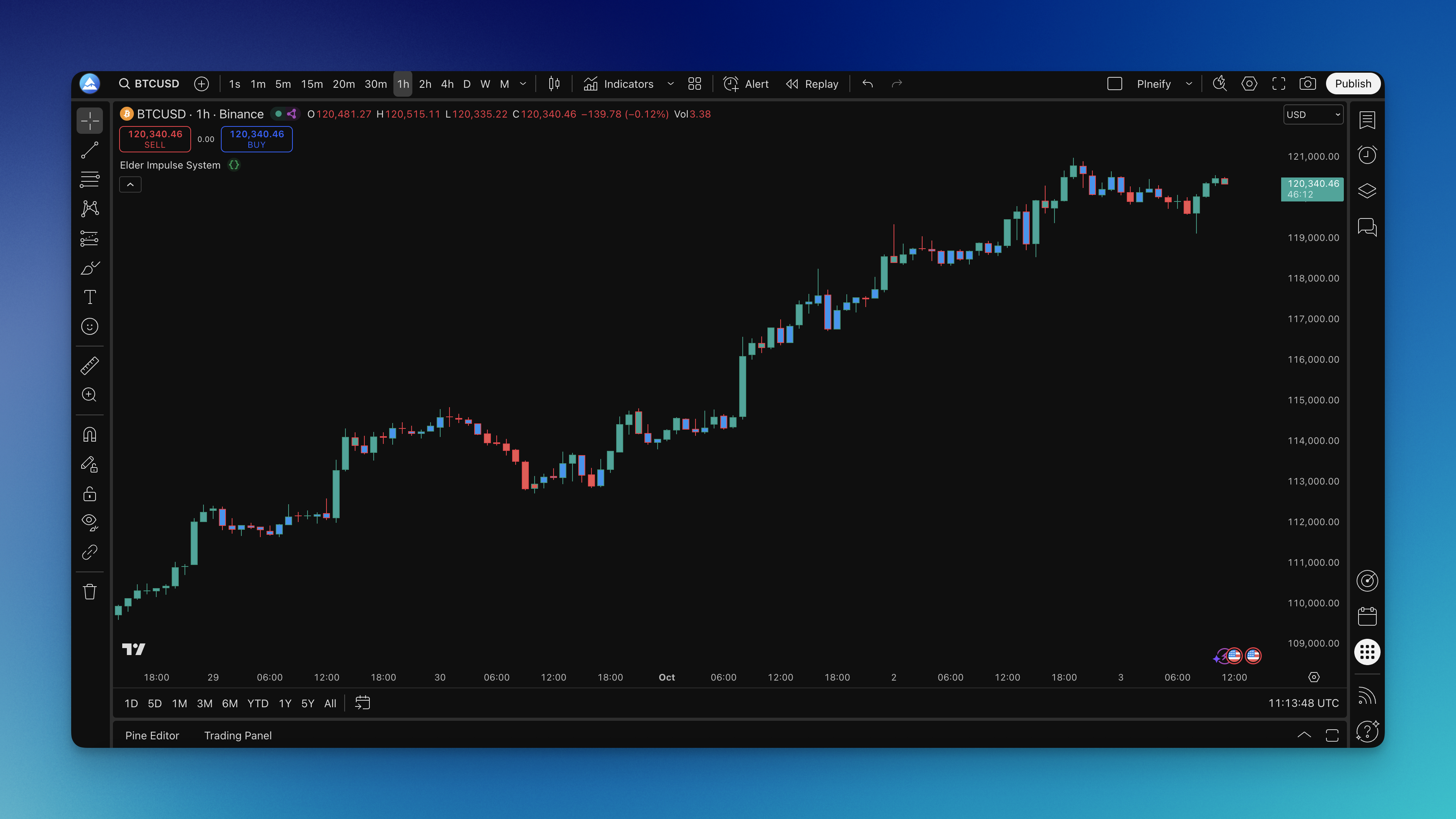
The Elder Impulse System combines the direction of an EMA with the direction of the MACD histogram. Both rising gives a bullish color; both falling gives a bearish color. Other combinations are neutral. The relevant EMA condition is its slope, not simply whether price is above it.
A color summarizes two calculations. It does not specify order size, entry timing, stop distance or expected return.
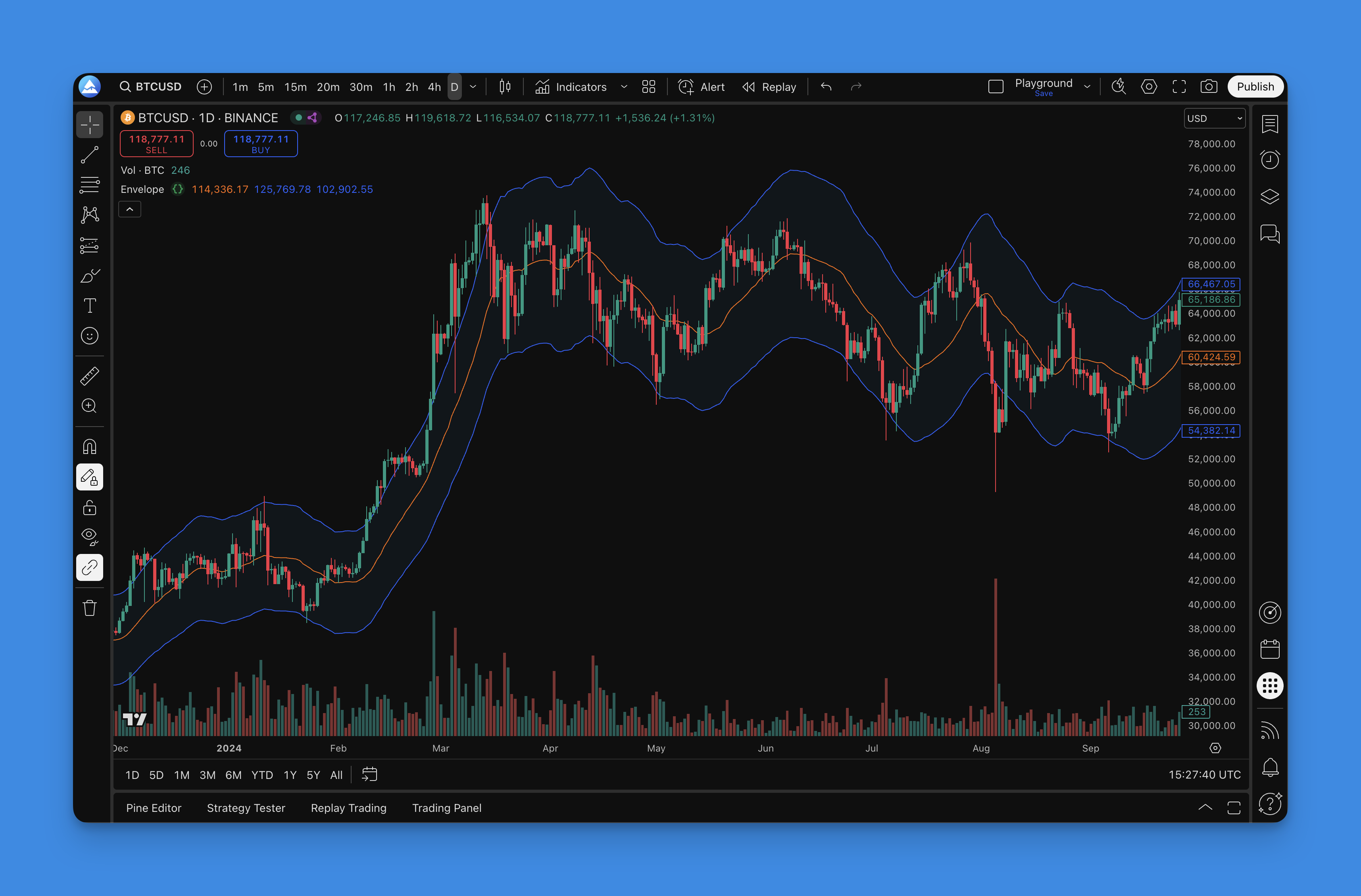
A moving-average envelope places bands a chosen percentage above and below a moving average. It measures distance from that average; touching a band does not by itself establish support, resistance or a reversal.
Knowing when the trend has actually flipped—instead of chasing noise—is one of the hardest parts of trend trading. HalfTrend (HT) is one indicator to evaluate for that purpose. It draws a single trend line that switches between support and resistance, plus an ATR-based channel around it, and it marks Buy and Sell only when the internal trend state changes. That keeps signals clear and avoids the clutter of many overlapping lines.
In the Pineify implementation, price comparisons and moving averages over the amplitude lookback determine trend transitions. ATR determines channel width and arrow offsets; it is not the trend-switch threshold. When the trend flips from down to up, you get a Buy signal and the line turns into support (often shown in blue); when it flips from up to down, you get a Sell signal and the line acts as resistance (often shown in red). The ATR High and ATR Low bands form a ribbon that shows the channel around the trend line. Compare amplitude values on the same symbol and period before choosing one. The examples below describe possible rules, not tested performance.